
Best Smart Thermostat have become a necessity in 2026 due to rising energy costs. As your energy bills get more and more expensive, you need a solution to lower your costs of heating and cooling your home. Are you looking at your expensive bills and wondering how all of that is spent? Well, there is hope yet because a Smart Thermostat could be your solution.
What is a smart thermostat? In other words, it is an advanced version of the usual thermostat that works on Wi-Fi and is operated by means of smartphones. Consider it to be like upgrading the brain of your house’s climate control unit.
The use of smart thermostats is now a key feature of any modern smart home and not without reason, as they have many advantages over the conventional thermostats:
- Save energy 💡 – Save up to 10-30% on your heating and cooling costs
- Remote control 📱 – Change the temperature anywhere, anytime with your smartphone
- Automation 🤖 – Create schedules and allow the thermostat to get used to your preferences
Nowadays, major companies such as Honeywell, Ecobee, and even Amazon produce thermostats that work effectively and reliably. No matter whether you are installing a smart home or upgrading an existing one, when picking a smart thermostat for 2026, keep in mind several important aspects.
For more details Official Source: ENERGY STAR Smart Thermostats
Table of Contents
What Is a Smart Thermostat?
An smart thermostat is a wireless gadget that regulates your home’s HVAC (heating, ventilation, and air conditioning) system, all thanks to the Internet. As opposed to ordinary dials or even programmable thermostats that you may be familiar with, this gadget will bring your temperature control system to the digital world.
How Smart Thermostats Work
There are various parts in smart thermostats:
Sensors: They measure temperature, humidity, and even presence. Some thermostats come with remote sensors, which you can install in other parts of your home.
Wi-Fi Connectivity: This enables communication between your smartphone and your thermostat, as well as weather notifications and updates.
Mobile Apps: Specialized apps will enable you to manage the settings on your thermostat from your mobile device while you are miles away from home.
Traditional Thermostat vs Smart Thermostat
The differences between traditional and smart thermostats are significant:
Traditional Thermostats:
- Simple temperature regulation
- Manual controls only
- No remote operation
- Few schedule settings
- No energy analysis
Smart Thermostats:
- Sophisticated temperature and humidity regulation
- Remote phone operation
- Compatibility with voice commands
- Flexible scheduling with different programs
- Energy consumption reports
- Learning abilities based on your habits
When someone asks you what a smart thermostat is, the simplest answer would be that a smart thermostat is like an assistant programmed to ensure that your home stays comfortable while saving you money on your electricity bill.
Benefits of Smart Thermostats
The benefits of installing a smart thermostat go beyond mere temperature control. The following are some of the most important benefits that you will enjoy from using such equipment:
Energy Savings (10–30%)
One benefit of smart thermostats is that they lower energy bills by 10-30% per year, due to their precise regulation of temperature and the savings made from not having to remember to adjust regular thermostats.
Remote Access Via Apps
No matter where you are – whether at work, relaxing on a holiday, or even lying in bed – you have the ability to instantly regulate the temperature of your home through your phone. This way, you can lower the thermostat temperature even after forgetting to do so before embarking on a long trip.
Voice Control Integration
The contemporary smart thermostats come hand-in-hand with voice controls such as Alexa and Google Assistant. All you have to do is to command “Alexa, set the temperature to 72 degrees,” or “Hey Google, how’s the temperature in the house?”.
Learning Behavior (AI-Based)
These models learn about your behavioral patterns over a period of some weeks. These will be aware of your normal time of leaving for work, coming back, and the temperatures you favor during specific times of the day.
Flexible Scheduling
Schedule your thermostat to have different temperatures on weekdays, weekend, and other special occasions. Set different temperatures according to morning, afternoon, evening, and nighttime for maximum comfort and cost savings.Top 7 Best Smart Thermostats in 20261. Honeywell Home T9 Smart Thermostat.
If you’re new to smart homes, check our guide on best smart home devices for beginners
Top 7 Best Smart Thermostats in 2026
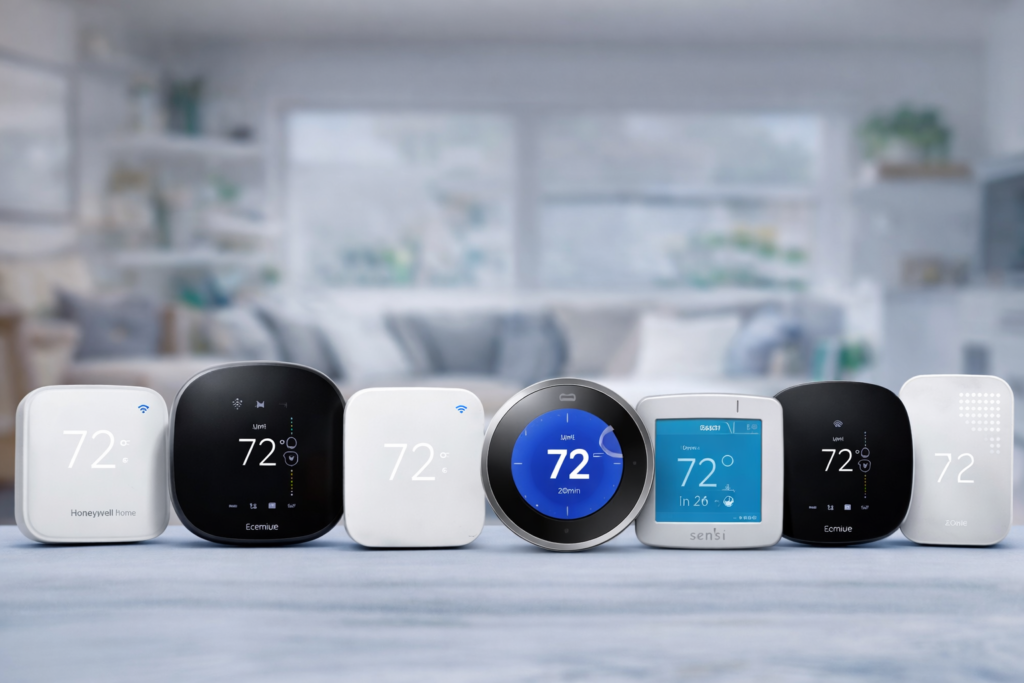
1. Honeywell Home Thermostat (Home T9 Smart)
Among the best-selling smart thermostats in 2026, the Honeywell thermostat Home T9 smart is considered one of the most reliable options on the market today. The product has been praised for its high-quality construction and reliable performance.
Key Features:
- Room sensors to control the temperature in several different rooms
- Automatic geofencing that detects when you’ve left home or returned
- Touchscreen display with easy navigation
- Compatibility with popular smart home systems
✅Pros:
- Reliability and high-quality construction
- High accuracy in controlling the temperature in different rooms
- Responsive customer service provided by Honeywell
- User-friendly app
❌Cons:
- Higher Price Than Competitors’ Options
- Separate Sensors Available for Multi-Room Applications
- Less modern interface when compared to other newer systems
Best for: This is perfect for homeowners who want something that works reliably without compromising on the price. Honeywell’s reputation in HVAC control spans multiple decades, and you won’t be disappointed.
2. Ecobee Smart Thermostat Premium
This Ecobee Thermostat Premium is the highest category of thermostats because it includes all advanced functions needed to control the climate properly.
Key Features:
- Integrated air quality sensor that controls VOCs and humidity levels
- In-built smart sensor that helps regulate room temperatures
- Integrated Alexa voice control system
- Occupancy detection capability
✅Pros:
- Great air quality monitoring system
- Good energy-saving mechanisms
- High-quality display and build
- Compatibility with smart homes
❌Cons:
- Premium Pricing
- Will not be suitable for people who use Google’s ecosystem
- Has more complicated setup process than standard models
Best for: People who are looking for all the advanced features offered and can afford them. Due to air quality testing, this model is perfect for individuals who have allergies or problems with breathing.
3. Amazon Smart Thermostat
The launch of Amazon into the market of smart thermostats involves affordability without compromising the necessary smart functions.
Key Features:
- Deeper Alexa integration with voice commands
- Tracking and reporting energy consumption
- Control from a simple smartphone application
- Production by Honeywell
✅Pros:
- Affordable pricing
- Smooth Alexa integration
- Ease of installation
- Good quality backed by Honeywell production
❌Cons:
- Lacks more advanced features when compared to high-end models
- Room sensors not included
- Simpler display when compared to touchscreen rivals
Best for: Cost-effective homeowners who are already into Amazon’s ecosystem and looking for smart thermostat features without paying a premium price.
4. Google Nest Thermostat
The Google Nest Learning Thermostat has introduced many new technologies which have become standards for today’s smart thermostats, including the 2026 edition.
Key Features:
- Learning capabilities which adjust to your routine
- Energy reports indicating usage statistics
- Attractive circular shape with high resolution screen
- Farsight capability which shows you information when you get close
✅Pros:
- Great learning abilities, thus minimizing the need for programming
- Stunning, unique design
- In-depth energy monitoring
- Effective Google home system integration
❌Cons:
- More expensive than other devices
- Requires some time for learning to achieve optimal operation
- Compatibility issues with certain older HVACs
Best for: Technology lovers interested in state-of-the-art AI functionalities and owners of the Google smart home ecosystem.
5. Sensi Smart Thermostat
Sensi Smart Thermostat by Emerson highlights the importance of user-friendly design and installation ease while offering intelligent capabilities.
Key Features:
- Simple installation process using a smartphone app
- Compatibility with most HVAC systems, not requiring a C-wire
- Seven-day scheduling capability
- Monitoring energy consumption
✅Pros:
- Extremely low cost
- Easy to install compared to other smart thermostats
- No need for a C-wire on most heating and cooling systems
- Straightforward and simple functioning
❌Cons:
- Old-fashioned design and interface
- Lacks many advanced functions
- Lacks many advanced functions
Best for: Beginners looking to buy their first smart thermostat without hassle.
6. Ecobee Smart Thermostat Enhanced
The Ecobee thermostat Enhanced is Ecobee’s mid-level product line, offering a wide variety of high-end features at an affordable price point.
Key Features:
- Single SmartSensor for controlling multiple rooms
- Energy-saving algorithms and comprehensive reports
- Voice control using both Alexa and Google devices
- Touch screen display
✅Pros:
- More affordable than Premium but still includes many features
- Very efficient energy use
- Well-made product and design
- Works well with smart home systems
❌Cons:
- No air quality sensors like in Premium version
- No voice assistant feature
- Mid-priced product won’t suit bargain hunters
Best for: People who want Ecobee’s qualities without purchasing their Premium model.
7. Mysa Smart Thermostat
The Mysa Smart Thermostat is best suited for electrical heaters since it is designed explicitly to control electric heater systems.
Key Features:
- It is specially designed for high voltage electric heater systems
- Minimalistic and stylish design available in several colors
- Zoned temperature control
- Energy monitoring for electric heaters
✅Pros:
- Designed specifically for electric heating systems, something overlooked by other manufacturers
- Attractive design that fits with any decor
- Very strong zone control
- Very focused on the efficiency of electric heaters
❌Cons:
- Only work with electric heating systems
- Smaller ecosystem than other bigger players
- Less third-party integration
Best for: People who use electric heating systems who want features that are made especially for their heating system.
For a complete setup, combine your thermostat with best smart plugs of 2026 for full home automation.
Comparison Table
| Model | Price Range | HVAC Compatibility | Voice Control | C-Wire Required |
|---|---|---|---|---|
| Honeywell T9 | $200-250 | Most systems | Alexa, Google | Yes |
| Ecobee Premium | $250-300 | Most systems | Alexa, Google | Yes |
| Amazon Smart | $60-80 | Most systems | Alexa | No* |
| Google Nest | $200-250 | Most systems | Usually | |
| Sensi | $80-120 | Most systems | Alexa, Google | No* |
| Ecobee Enhanced | $170-200 | Most systems | Alexa, Google | Yes |
| Mysa | $120-150 | Electric only | Alexa, Google | N/A |
*Some installations may still require C-wire depending on system type
How to Choose the Best Smart Thermostat
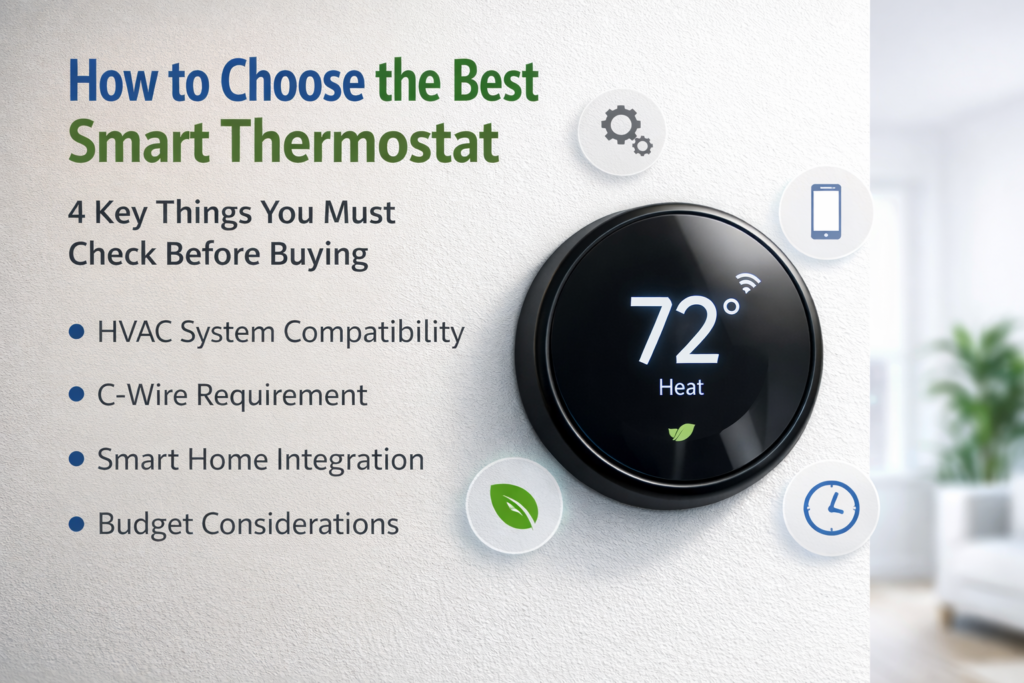
Choosing a suitable smart thermostat requires consideration of a number of critical elements to ensure that it meets your needs and is compatible.
HVAC System Compatibility
Before becoming smitten by one specific device, make sure it is compatible with your existing HVAC system, as most are compatible with:
- Central air and heating units
- Heat pumps
- Furnaces fueled by gas, oil, and electricity
- Boiler systems
However, certain types of HVACs may not be compatible with some smart thermostats. It is important to check the wiring of your existing thermostat against your preferred smart thermostat’s requirements.
C-Wire Requirement
However, most of the smart thermostats will demand power via what is known as a C-Wire (Common Wire). The C-Wire is responsible for powering the device to enable its Wi-Fi connectivity and display. If there is no existing C-Wire, you can choose either of the following methods:
- Select a thermostat that does not require it
- Install a C-wire adaptor
- Hire an electrician to install a new wire
🤖Smart Home Integration
Think about your current smart home environment:
- Amazon Alexa users: Amazon Smart Thermostat or devices that work well with Alexa
- Google ecosystem: Google Nest or devices compatible with Google Assistant
- Apple HomeKit: Ecobee devices can be connected via HomeKit
- Multiple platforms: Look for models supporting all major platforms
Most smart thermostats support voice assistants. Read our Alexa vs Google Home comparison to choose the best one.
💰Budget Considerations
Smart thermostats are priced between $60 and more than $300. Think about the total cost, which includes:
- Price of the smart thermostat itself
- Installation costs if hired someone else
- Extra sensors or accessories
- Potential Energy savings
Installation Difficulty
How comfortable are you with working with electricity?
- DIY-friendly: Sensi, Amazon Smart Thermostat
- Not too complicated: models with clear instructions
- Hire an expert: Complex equipment or poorly wired house
Smart Thermostat Without C-Wire
Knowledge about c-wire specifications can keep you out of trouble with regard to compatibility problems.
What Is a C-Wire?
C-wire stands for common wire. This component serves to supply constant 24 volts of power to your thermostat. The reason why earlier thermostats did not require constant power is that they used to complete a circuit when they called for heat/cooling.
- Wi-Fi connectivity
- Display operation
- Processing and learning algorithms
- App communication
Options for Homes Without C-Wire
Power Extender Kits: Most companies offer power extenders, which help supply the energy needed from your existing wiring.
Battery-Powered Models: Some smart thermostats can run using batteries but with limitations.
Adapter Installation: It is also possible to install an adapter at your HVAC system that provides energy needs.
Best Models Without C-Wire Requirements
- Amazon Smart Thermostat: Compatible with almost all systems with no extra wires needed
- Sensi Smart Thermostat: Features a power extender kit
- Some Honeywell models: Have alternatives for systems without C-wire
Keep in mind that “no wire C-wire” does not mean your thermostat will not require C-wire.
Best Smart Thermostats Without C Wire (2026 Guide)
Installation Guide Overview
The installation of a smart thermostat can easily be done at home, depending on the device model and current system configuration.
1.Basic Installation Steps
Turn Off Power: The most essential part of installing any new thermostat is ensuring that all power connections are cut. It is imperative that no risk of electricity flow exists during installation.
Remove Old Thermostat: Ensure that you take pictures of your old thermostat to understand which wire goes where. Then, gently remove the previous thermostat from the wall.
Connect New Wires: Using the instructions provided with your new thermostat, connect the wires with the terminals according to the diagram.
Mount and Configure: Mount your new thermostat, and set up its settings in the mobile application.
2.Installation Difficulty Levels
Easy (30-45 minutes): Installations taking 30-45 minutes where current wiring meets the specifications of the new system exactly.
Moderate (1-2 hours): Installations involving the use of power extension kits or slight alterations in the current wiring system.
Complex (Professional recommended): Installations that require extensive wiring alterations, multi-stage installations or houses whose wiring is different from the norm.
Most homeowners can manage easy to moderate installation tasks. In case of doubt, getting a professional to install the device is the best way forward and will help protect the product’s warranty status.
Smart Thermostat vs Traditional Thermostat
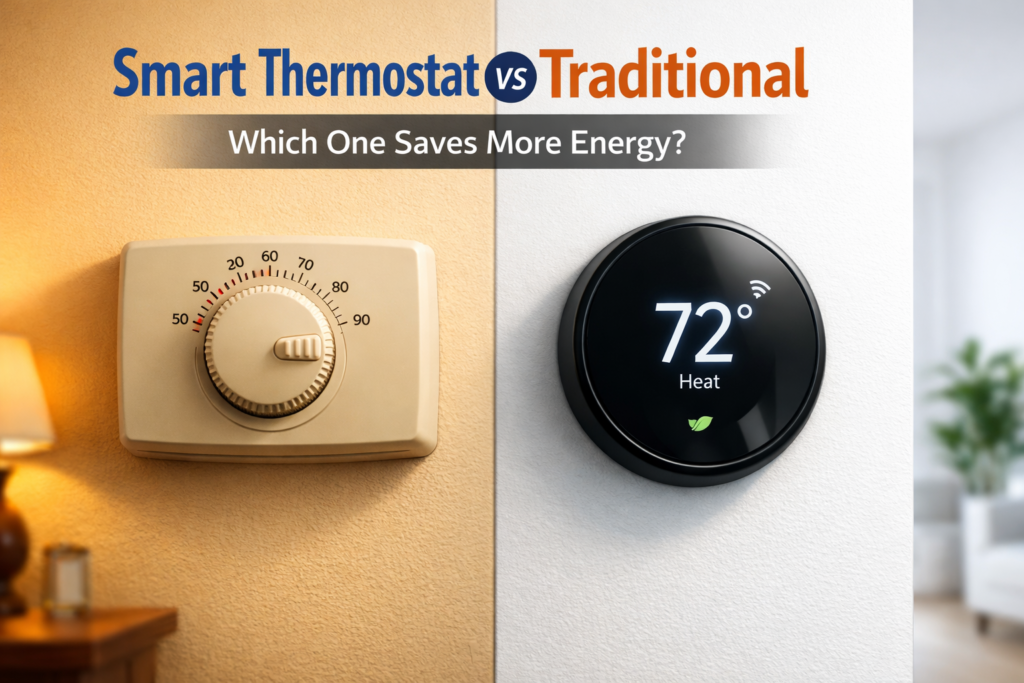
Choosing between smart and traditional thermostats is done by evaluating their various aspects.
Feature Comparison
Traditional Thermostats:
- Simple temperature control function
- Basic programmability
- No recurring costs after purchase
- Manual operation
- No insight into energy use
Smart Thermostats:
- Remote control using smartphones
- Automation and advanced scheduling
- Energy monitoring and reporting
- Controlled by voice command
- Learning abilities
- Weather prediction
- Upgradable software with new features
Cost vs Savings Analysis
Upfront Costs:
- Programmable Thermostat: $25-$100
- Smart Thermostat: $60-$300
- Professional Installation: $100-$200
Ongoing Savings:
The smart thermostats save energy and result in 10%-30% saving on heating and air conditioning costs. The average annual cost of heating and cooling the house is around $1,200, resulting in saving between $120 and $360 per
👍Which Is Better in 2026?
However, the benefits of smart thermostats in 2026 for many homeowners will outweigh their high initial price, making them a worthwhile investment for:
- Homeowners intending to live in their houses for a prolonged period
- Individuals interested in smart home devices
- Travelers and those who have unpredictable timetables
- Families concerned about energy efficiency
Conventional thermostats will continue to be useful for:
- Rented property in which the smart functionality would be underutilized
- Budgets that are extremely tight
- Old buildings with old heating ventilation and air conditioning units
❓FAQs
What is the best smart thermostat in 2026?
The “best” smart thermostat depends on your specific needs:
- Overall best: Ecobee Smart Thermostat Premium for its comprehensive features
- Best value: Amazon Smart Thermostat for budget-conscious buyers
- Most reliable: Honeywell Home T9 for proven dependability
- Best learning: Google Nest Learning Thermostat for AI capabilities
Do smart thermostats save money?
Absolutely, smart thermostats usually provide savings between 10 to 30 percent by improving scheduling and providing better temperature control and occupancy detection. The level of savings is dependent upon how you use your existing thermostat and energy prices in your area.
Can I install a smart thermostat myself?
Yes, if you feel confident in your electrical skills and your home is equipped with wiring for a smart thermostat, you can definitely do this by yourself. The installation takes up to 1 hour on average.
Do I need Wi-Fi for a smart thermostat?
Definitely! The absence of Wi-Fi means no ability to remotely operate the device, use mobile apps, update firmware, and implement other capabilities which give the device its “smart” status.
Which is best: Ecobee or Nest?
Both options make perfect sense, each having its own pros:
- Ecobee: More cost-effective; comes with a room sensor, works with more smart home devices, has air quality monitoring with Premium version
- Nest: Offers superior learning capabilities, has an appealing design and works well with Google products
Select either Ecobee or Nest, depending on your needs and preferences.
🔗Related Articles
- Smart Thermostat Not Turning On? 12 Proven Fixes That Work Instantly (2026 Guide)
- Honeywell Smart Thermostat Review: Shocking Truth – Is It worth It? (2026)
- Smart Thermostat Installation (Step-by-Step Guide)
- Amazon Smart Thermostat Review & Setup Guide (2026)
- Sensi Smart Thermostat Review (Budget Pick?) – Honest 2026 Guide
- Smart Home Setup Under 200$ (2026 Budget Guide): Build a Smarter Home for Less
- What Is Matter in Smart Homes? Complete Beginner’s Guide (2026)
🚀Conclusion
Selecting a proper smart thermostat in 2026 will require matching the product’s specifications to your own unique requirements and budget. According to our extensive analysis, the following is recommended:
Budget Choice → Amazon Smart Thermostat: Amazon Smart Thermostat: Priced at only $60-80, this provides great value and all necessary smart functions with solid Alexa compatibility. Ideal choice for novice smart thermostat users seeking affordable reliability.
Premium Choice → Ecobee Smart Thermostat Premium:Ecobee Smart Thermostat Premium: At an average cost of $250-$300, this thermostat will provide you with air quality monitoring, room sensor included, and the complete package of features. Best for those who like to have the newest technology but are willing to pay for it.
Reliable Choice → Honeywell Home T9: Honeywell Home T9: For $200-$250, this is a great choice as it combines reliability and smartness. The well-known name of Honeywell guarantees the expertise in the field of heating, ventilation, and air conditioning systems.
Keep in mind that any smart thermostat will definitely recover its cost through savings on energy bills within 1-3 years, along with offering numerous advantages not available with conventional thermostats.
Ready to upgrade your home’s climate control? Check latest prices on Amazon and take the first step toward a smarter, more efficient home. Your future self will thank you every time you adjust the temperature from your smartphone or see those lower energy bills.
The smart home concept is upon us, and there is no better way to experience the benefits it offers than by upgrading your thermostat.
Pingback: Smart Thermostat Installation: 7 Easy Steps
Pingback: Best Smart Thermostats Without C Wire: 7 Easy Picks (2026 Guide)