
“Best Smart Thermostats Without C Wire” is one of the hottest search queries among those who want to upgrade their house with smart home solutions in 2026. You decided to upgrade your house and installed a smart thermostat, only to find that there were not five wires like you expected but only a couple. But this is not your case only.
There are millions of homeowners facing the same problem. The C-wire (common wire) became the key element of all smart thermostats due to its ability to supply electricity to these devices, ensuring their wifi capability. Without the C-wire, most homeowners feel that they are unable to use any smart technology in their house, or that they need expensive rewiring work.
And the good news is: you can still fulfill your aspirations of having a smart house without resorting to professional help and without tearing down the walls of your living space. Indeed, the market of smart thermostats has changed tremendously, and many companies have already provided a wide array of smart thermometers that fit perfectly for those who do not have C-wire installation.
Whether your house is old, having been built before the existence of contemporary HVAC systems or just has an ordinary heating system that doesn’t need a C-wire at all, you can install a smart thermostat easily. Here, I am going to look into the most effective wifi thermostats that do not require a C-wire, allowing you to install them in your home comfortably.
You will be surprised how many options there are when it comes to smart thermostats that don’t require C-wires..
learn more about smart thermostats
Table of Contents
What Is a C-Wire?
The C-wire is an abbreviation for common wire. In simple terms, it is the power return wire on your thermostat’s electrical circuitry. Just like how neutral wire works on your normal household electrical wiring system, it forms part of the circuit allowing for power to travel continuously.
On conventional home heating and cooling systems, the C-wire transports 24 volts of alternating current from your air conditioner back to your thermostat. The two form an electrical circuit through which power is constantly supplied. With such continuous flow of power, smart thermostats function correctly. They will be able to utilize such features as wifi capability and touchscreen technology among others.
In order to better understand how a C-wire works, you should picture it as a power outlet to your smartphone. In the same way that your phone requires an electrical charge for it to perform its functions, a smart thermostat will require an electrical supply in order to facilitate connectivity and scheduling and enable communication with the heater and AC.
The C-wire is commonly either blue or black, but depending on when your wiring was done, it might be any other color. The C-wire is connected directly to the “C” terminal on both the thermostat and the controller on the heater/AC unit.
But just because there is no C-wire present does not mean that there is something wrong with your electric system or that it is obsolete. There are many HVAC systems that are fine despite lacking a C-wire, particularly since they were initially intended for use with a mechanical thermostat.
Why Many Homes Don’t Have a C-Wire
The fundamental cause of why most houses don’t have a C-wire can be traced to the concept of timing and necessity. Houses that were constructed prior to the 1990s relied on simple HVAC systems powered by conventional mechanical thermostats. The mechanical thermostats did not require any constant power since their functionality was purely dependent on manual manipulation of the system’s operation.
In the time frame under discussion, it was common practice to run only four wires for a thermostat: one wire for heating, another wire for cooling, a third wire for the fan control, and a fourth wire for power. Since these mechanical thermostats had the capability of drawing small amounts of power from the existing wires whenever necessary, the installation of a separate C-wire became unnecessary.
Even some new houses may not contain a C-wire when they have been designed with inexpensive heating equipment such as baseboard heating, inexpensive heat pumps, or economical HVAC installations. Contractors opted for the most cost-effective wiring systems to meet the requirements of the current thermostat installation.
Furthermore, it can be noted that while a number of houses have C-wires installed near their HVAC system, they remain unconnected in the wall of the thermostat. It is possible that, during initial installation of the thermostats, some contractors chose to coil the wire in the wall since it was unnecessary at the moment of installation. In this case, the homeowner may have C-wires in the house, but they must be found and connected first.
The advent of smart home devices has led to a mismatch between how most homes are wired and the demands that a modern thermostat places on those wires. Yet, this very mismatch has been an important factor in spurring innovation within the realm of smart thermostats.
Can You Use a Smart Thermostat Without C Wire?
YES – You definitely can install a smart thermostat without a C-wire in your home, and you actually have several ways to do it.
Smart thermostats manufacturers managed to come up with three key solutions that address the C-wire issue in the best possible way.
Battery-powered models constitute the easiest option. In such cases, these intelligent thermostats contain rechargeable batteries that serve as a back-up power source whenever the device fails to extract sufficient electrical energy through the wire of your house. These batteries generally work for six to twelve months without requiring charging and in most cases, notify you through your phone in case the batteries need charging.
Power stealing technology may be considered the most elegant of all. Such sophisticated thermostats are capable of “stealing” some power off your wires from the old thermostat. As soon as the heating or cooling system starts working, the sophisticated device “steals” some electricity and saves it in
Adapter and power extender kits serve as a compromise between the two solutions mentioned above. Adapter kits generally consist of a small adapter that plugs into the control board of your heating ventilation air conditioning system and uses the wiring in order to generate extra power needed by the smart thermostat. Most reputable smart thermostat producers provide adapter kits for their devices; installation generally takes 15-30 minutes.
Both methods have proved effective when applied in practice. The difference is in selecting one of them in accordance with particular parameters.
Best Smart Thermostats Without C Wire
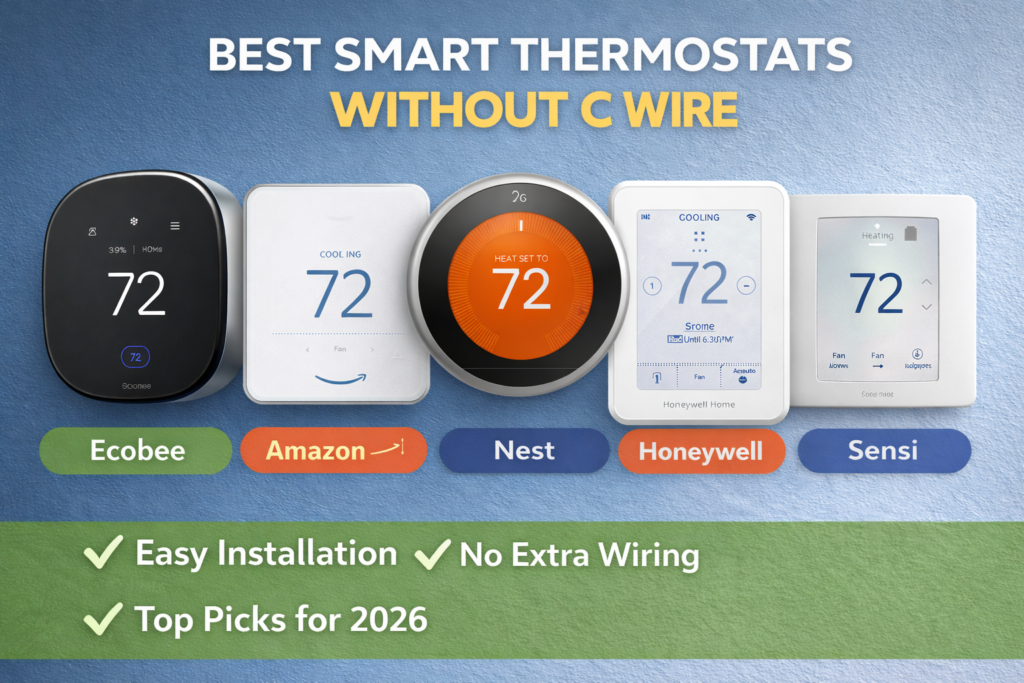
🥇 1. Ecobee Smart Thermostat Premium
In terms of a great thermostat without C-wire complications for advanced users, we would recommend the Ecobee Smart Thermostat Premium. With everything needed to install it in almost any setting and despite possible C-wire complications, the unit provides a number of additional features.
It should be noted that the Ecobee Smart Thermostat Premium is equipped with the built-in Alexa technology, thus allowing to manage the system or control other smart home devices and play music by using only voice commands. Moreover, the room sensors that come with the thermostat monitor temperatures and presence of people in each particular area of your home.
Some of the added benefits of the premium version include such things as air quality sensing that can detect levels of humidity in addition to letting you know when to replace the air filter. The interface is touch-screen based and works really well while offering some of the most comprehensive scheduling capabilities on the market.
Easy installation is one of the main advantages since there is the power extender kit available as well as instructions that walk you through everything. This is complemented by having the Ecobee application help you set everything up. They also have top-notch customer support services available.
Best for: Advanced users who want comprehensive smart home integration and don’t mind spending more for premium features.
🥈 2. Amazon Smart Thermostat
Amazon Smart Thermostat is a great option for those who wish to enjoy smart features without having to sacrifice their finances. The design of the thermostat was developed by Honeywell and emphasizes the practicality of features that will work effectively for you.
Voice control of the device is provided via Alexa, allowing you to change the settings, set up a schedule, and monitor the consumption of energy with your voice through any of your Alexa devices. It is easy to set up due to clear guidance during installation. The power consumption of the device is small, and it doesn’t need a C wire for installation.
Despite lacking room sensors seen in higher end models, the Amazon Smart Thermostat is capable of smart scheduling to accommodate your needs through learning about your preference over time. Energy saving options will be beneficial by lowering your monthly utility bill costs, and Amazon usually offers rebates when setting up their thermostat.
The application interface is simple yet effective by showing only the controls you would need and no more. You can change your temperatures quickly using the interface while also utilizing geofencing capabilities to control the temperature settings in your home according to your presence or absence.
Best for: Beginners who want reliable smart thermostat functionality at an affordable price point with easy Alexa integration.
🥉 3. Google Nest Learning Thermostat
With the Google Nest Learning Thermostat, you get to integrate artificial intelligence into your HVAC system; hence, this product is perfect for any modern home that favors automation and energy efficiency. It learns your personal schedule and creates the most appropriate program automatically without your need to enter any commands manually.
The device has a very appealing design with its round-shaped interface that blends perfectly with the walls and at the same time provides a convenient way for controlling your climate control system. It consists of metal, which makes it look expensive. Additionally, the display adapts its brightness according to the lighting in the room.
Energy management has been made possible by the power-stealing technique used by Nest, which has evolved from one generation of thermostats to another. The product has the ability to interact efficiently with variable-speed HVAC and heat pumps.
The product has a great level of integration with the Google Assistant and other Google smart home devices. You can operate the thermostat using voice command, along with other Nest products such as smoke alarms and security cameras. Energy reports are also available within the Nest app, explaining in detail how your consumption affects your billings.
Best for: Smart homes that want automated learning features and seamless integration with Google’s ecosystem of products.
check thermostat compatibility
🏅 4. Honeywell Thermostats Home T9 Smart
Honeywell smart thermostat Home T9 Smart Thermostat is the fusion of the quality reputation of HVAC equipment and smart functionality, which make it suitable for people who value reliable products. The skills and experience of the company are evident from the high-quality design and features offered by the device.
Another benefit of the product under review is that it comes with several well-designed room sensors that work perfectly and do not require changing batteries often. They can be installed in bedrooms, living rooms, or home offices in order to ensure the appropriate temperature and humidity levels. Besides, the device averages the temperatures of occupied rooms, preventing any warm or cold zones.
The main advantage of T9 is its installation flexibility. It can operate using the supplied power adapter in case of C-wire installations; however, it can also operate independently from the power adapter. This information can be checked using the Honeywell site’s compatibility checker.
It has an intelligent schedule that can remind users about required maintenance or filters replacement. The touch screen is responsive and user-friendly, and it has big numbers which can be seen from a distance. The device is compatible with Amazon Alexa, Google Assistant, and Apple HomeKit.
Best for: Users who want reliable performance from a trusted HVAC brand with flexible installation options and room sensor capabilities.
🏅 5. Sensi Smart Thermostat
Sensi Smart Thermostat Installation Process One of the main features of the Sensi smart thermostat is its easy installation process. In addition, it works reliably and doesn’t require complicated wiring connections. Sensi works with existing thermostat wires found in nearly all households, which means that no adapter or power kit is needed during the installation.
The installation process is indeed easy. Many customers install the device within half an hour. All the terminals are marked appropriately, and all the instructions use clear language instead of technical terms. The Sensi app contains a compatibility check and installation guide illustrated with pictures.
Though the feature list may be a bit less extensive than more advanced units, the Sensi manages to incorporate all the important smart thermostats’ abilities. These include the ability to set schedules, remotely control temperatures, track energy usage statistics, and even set up geofencing which will automatically adjust the temperature depending on where you are.
Build quality of the device is very good; its simple rectangular shape matches any home interior. The screen is very legible, and the buttons are great for making manual adjustments. The battery life of the backup power source is fantastic – it lasts much more than a year without having to replace it.
Best for: Users who want hassle-free installation and reliable basic smart thermostat features without complexity or premium pricing.
Not sure which model to buy? Explore our complete smart thermostat buyer’s guide for 2026 before starting installation.
How to Install Without a C-Wire
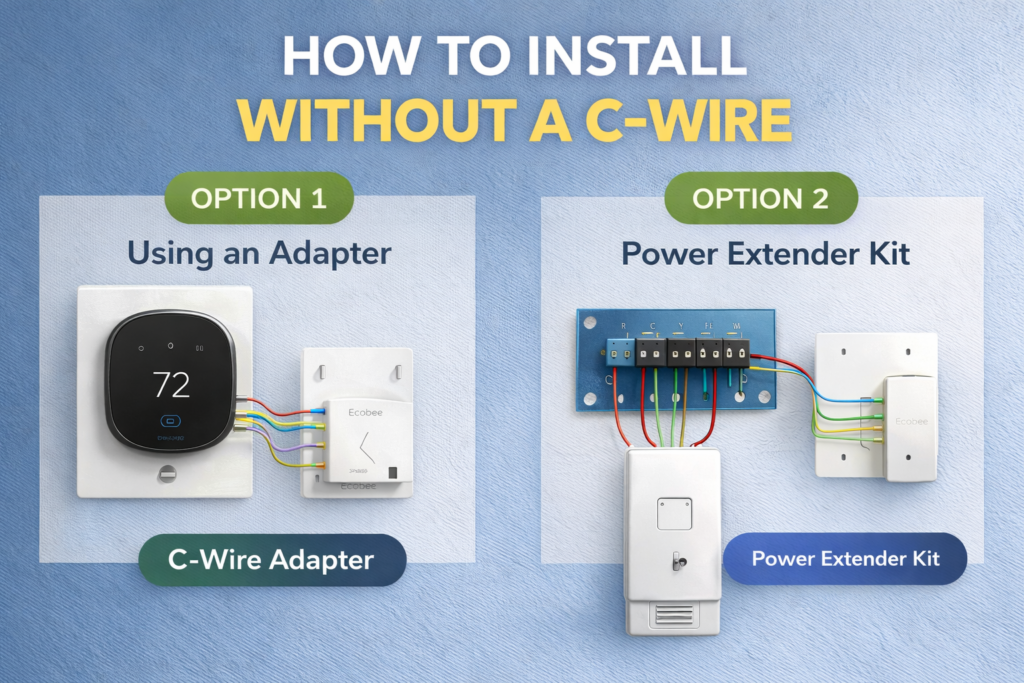
A smart thermostat installation without the C-wire will prove to be simpler than expected by many homeowners because of the adapter solutions provided by all thermostat manufacturers in recent years.
Using a Power Adapter Kit is another popular method. The kit usually consists of a small adapter box, which connects to your HVAC control board, as well as an additional wire that will connect the adapter box to your thermostat. First, you need to disconnect power supply to your HVAC system at the circuit breaker. Find the control panel for your furnace/air handler and locate the terminal board where your old thermostat wiring ends.
Your power adapter box will connect to two particular terminals in your terminal board (usually labeled as R and C), and the extra wire will connect your adapter to the thermostat. As you may have guessed, the whole process may seem complicated, but all of the necessary information is provided in your adapter kit.
Power Extender Kit Installation is quite similar but usually contains more elements for complicated heating and air conditioning systems. Power Extender Kits usually function within HVAC systems featuring several heating and cooling stages or heat pumps. The process usually takes 20-30 minutes and involves basic equipment such as screwdrivers and wire strippers.
Modern smart thermostats are now equipped with various features, including videos for installation with links provided via QR codes in the box and live chat assistance. Take pictures of the current wiring configuration prior to uninstalling your current thermostat as this step may save you hours of troubleshooting.
For detailed step-by-step instructions specific to your HVAC system, check out our comprehensive Smart Thermostat Installation Guide.
Compatibility Check
Before you make any purchases, ensuring your smart thermostat is compatible with your heating and cooling system will prevent any frustration from happening later on. Not all heating and cooling units require the same power supplies and wiring to operate correctly.
Traditional forced-air systems using gas furnaces and central air conditioning units tend to provide more flexibility in selecting thermostats since they have a normal voltage of 24V that suits power-stealing systems. In addition, most smart thermostats can be used in both single-stage and multiple-stage heating or cooling processes, although you should verify the exact number of stages.
Heat pump systems require extra care since these systems function in a way that differs from conventional HVAC systems. Heat pumps require a thermostat capable of switching from heating to cooling mode and controlling the auxiliary heat source. Be sure to choose a smart thermostat specifically built for use with heat pump system and to consider what kind of system you have – either single stage or multi stage heat pump system.
Electric baseboard heater systems can be considered difficult to deal with due to the fact that they use 120V and 240V power as compared to the 24V power that regular smart thermostats rely on. Such heaters will not be able to function properly with regular smart thermostats, since no such device would connect with a heater running on 120V or 240V voltage.
Hydronic or radiant heating systems it is common to find low-voltage control systems, which could work well with conventional smart thermostats. However, you must be careful with the exact voltage used in the system and how it is controlled. In some cases, there are hydronic systems controlled by line voltage, which will need special thermostats.
Most companies manufacturing thermostats offer online checkers for compatibility purposes.
Common Problems Without C-Wire
Although a smart thermostat without a C wire can perform very well, knowing possible pitfalls will guide you to the most suitable model and set your expectations.
Power-related connectivity issues are usually the most common problems with these thermostats. Power-stealing smart thermostats can experience a momentary loss of wifi connection during times when the HVAC system stays inactive for too long. It usually occurs when there is no need for heating or air conditioning since the weather is mild. Thus, there is enough time for the accumulated energy in the thermostat to get exhausted, leading to disconnecting from your Wi-Fi network.
Battery drain concerns there may be worries that their batteries will not last long. Although most batteries should last from 6 to 12 months, some users may have to charge or replace them in 3 to 4 months due to high consumption or outdated equipment.
Display dimming or shutdown may happen if the thermostat cannot sustain enough power to run all its functionalities. In such cases, your device can still effectively operate your HVAC system while decreasing power consumption from the display or wifi functionality. That does not indicate malfunction – that is just a safety measure, however, one which can confuse people.
Inconsistent smart features capabilities may arise as power becomes less stable throughout time. Smart capabilities like geofencing, advanced scheduling, or connection with other smart devices will experience difficulties functioning correctly if the thermostat fails to sustain stable power.
All of the above problems can be solved easily by proper installation of power adapters that come with thermostats, checking compatibility with your particular HVAC unit, or buying another, more suitable smart thermostat. Newer smart thermostats cope much better with power restrictions than their predecessors.
Pros & Cons of No C-Wire Thermostats
✅Pros:
- Easy installation without the need for rewiring your house or calling an electrician saves you time and money
- No alteration required to your current HVAC system or home wiring
- High degree of compatibility with old houses and standard heating systems
- More cost-effective way of adding smart home capabilities without much electrical work
❌Cons:
- Power restrictions that could impact some capabilities when your HVAC is inactive for a long period of time
- Battery replacement in case your thermostat is using alternative power sources
- Occasional power interruptions during difficult power situations
- Lack of reliability for certain capabilities compared to thermostats powered by a C-wire
Advantages far outweigh disadvantages for the majority of people, considering the technological advancements in power management and batteries for smart thermostats.
Buying Guide
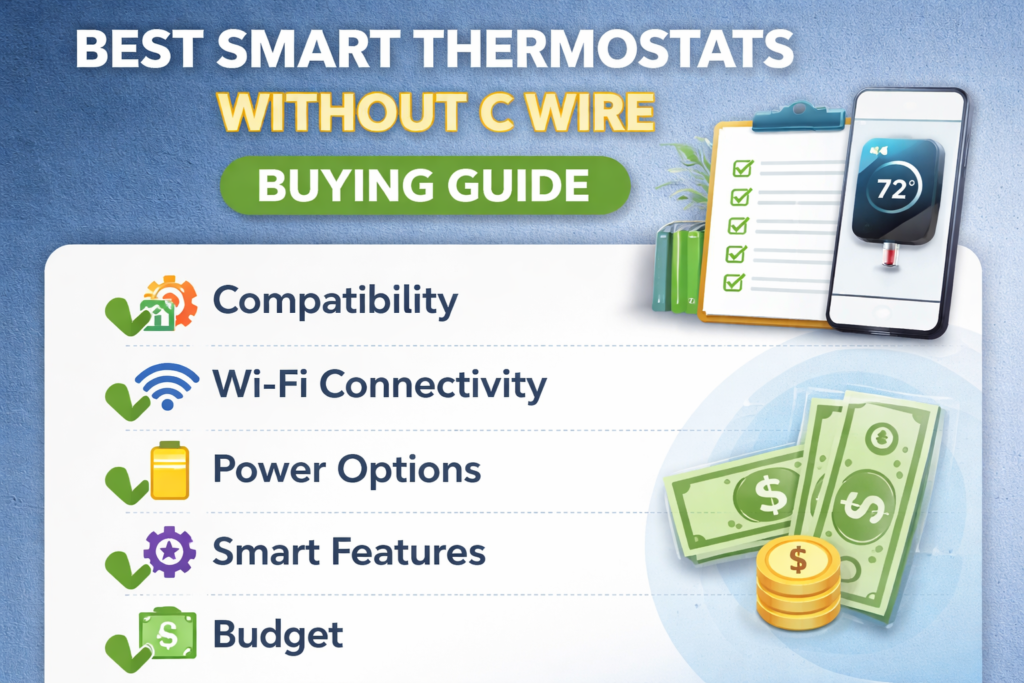
Making the right choice when selecting a smart thermostat that does not use C-wire means looking into various important things that would help in making a decision.
🔌 Compatibility is one thing you need to consider. You can either try using the online checker provided by the thermostat brand in question or contact customer support for assistance. You especially have to check heat pump compatibility and other aspects of the HVAC system that matter.
📶 Wi-Fi connectivity requirements needs differ based on the model. Take into account the strength of your Wi-Fi connection in the area where the thermostat will be installed. In case you struggle with connectivity issues, select devices with enhanced Wi-Fi signals or the ones supporting mesh networks.
🔋 Power options is vital, as well. Decide which system you would feel comfortable installing, taking into account your proficiency level when it comes to installing the unit. For example, do you want an option where the device runs on batteries that require charging or changing?
🤖 Smart features The capabilities that a device has need to be in line with your requirements and not only look fancy but also work for you. In case voice controls interest you, make sure that your chosen smart thermostat will work well with your other devices. Also, consider getting those that provide information on energy usage and have scheduling options.
💰 Budget considerations Not only the purchase itself, but maintenance and any additional features (subscription services, replacement batteries) need to be considered. Utility companies usually provide rebates for such devices to cover the expenses.
It might also be helpful to read reviews written by people with a similar HVAC system to yours and reach out to the manufacturer with further questions.
❓FAQs
Can I install a smart thermostat without a C-wire myself?
Yes, smart thermostats that don’t require a C wire are usually accompanied by an installation manual along with necessary adapters that allow installing the device by yourself. Installation of such a smart thermostat will take about 30-60 minutes and you will need to have a screwdriver only. Yet, if you find it difficult to work with electricity or your heating system is highly complicated, you should definitely ask an expert to install your new smart thermostat.
Which is the best smart thermostat without C-wire for beginners?
Amazon Smart Thermostat is considered to be the most suitable device for beginners as it has the simplest installation procedure, is easy to operate and comes with basic but rather useful smart functions. Sensi Smart Thermostat is another great device for beginners.
Is it safe to install a smart thermostat without rewiring?
Yes, it’s completely safe when you follow manufacturer instructions and use approved adapter kits. Smart thermostats designed for no-C-wire operation include built-in safety features and have been tested extensively for safe operation with various HVAC systems. Always turn off power to your HVAC system before beginning installation and consult professional help if you’re uncertain about any aspect of the process.
Do I need an adapter for every smart thermostat without C-wire?
Not always. There are some smart thermostats that can function effectively using the power-stealing technology or battery packs without needing any adapter at all. Most other models come with adapter kits, although whether you will need one is dependent upon your particular HVAC unit and the thermostat itself.
Will a smart thermostat without C-wire work with my heat pump?
Yes, most smart thermostats without C-wire are compatible with heat pumps. That being said, you will still need to pick out a thermostat that specifically supports heat pumps due to the particular nature of heat pumps and their operations.
🔗Related Articles
- Amazon Smart Thermostat Review & Setup Guide (2026)
- Smart Thermostat Not Turning On? 12 Proven Fixes That Work Instantly (2026 Guide)
- Honeywell Smart Thermostat Review: Shocking Truth – Is It worth It? (2026)
- Smart Thermostat Installation (Step-by-Step Guide)
- Sensi Smart Thermostat Review (Budget Pick?) – Honest 2026 Guide
- Best Smart Thermostat Under $150 USA (2026 Guide)
🚀Conclusion
Non-C wire smart thermostats have come a long way from being mere stopgap measures to becoming high-performance units with reliable performance even in houses wired in the normal way. Be it the high-performance Ecobee Smart Thermostat Premium, the reliable and inexpensive Amazon Smart Thermostat, or the intelligent Google Nest, any of these thermostats will make your home comfortable without having to do any re-wiring work.
All it takes is the selection of an appropriate thermostat depending on the type of HVAC system and installation methods preferred. There are battery-operated thermostats, power stealing units, and even adapters that help get around the C wire problem.
Keep in mind that the installation process is much simpler than homeowners believe, especially because there are many helpful guides provided by manufacturers these days. In most cases, problems regarding compatibility could be easily avoided using manufacturers’ compatibility tests.
Choose the right smart thermostat without C-wire and upgrade your home easily. Start by checking compatibility with your HVAC system, consider your budget and desired features, and take advantage of available utility rebates to make your smart home upgrade both affordable and effective.What Is a Smart Hub? Complete Guide for Beginners (2026)10 Best Smart Home Devices for Beginners (2026 Guide)
Pingback: Best Smart Thermostat 2026 (Complete Buyer's Guide)