
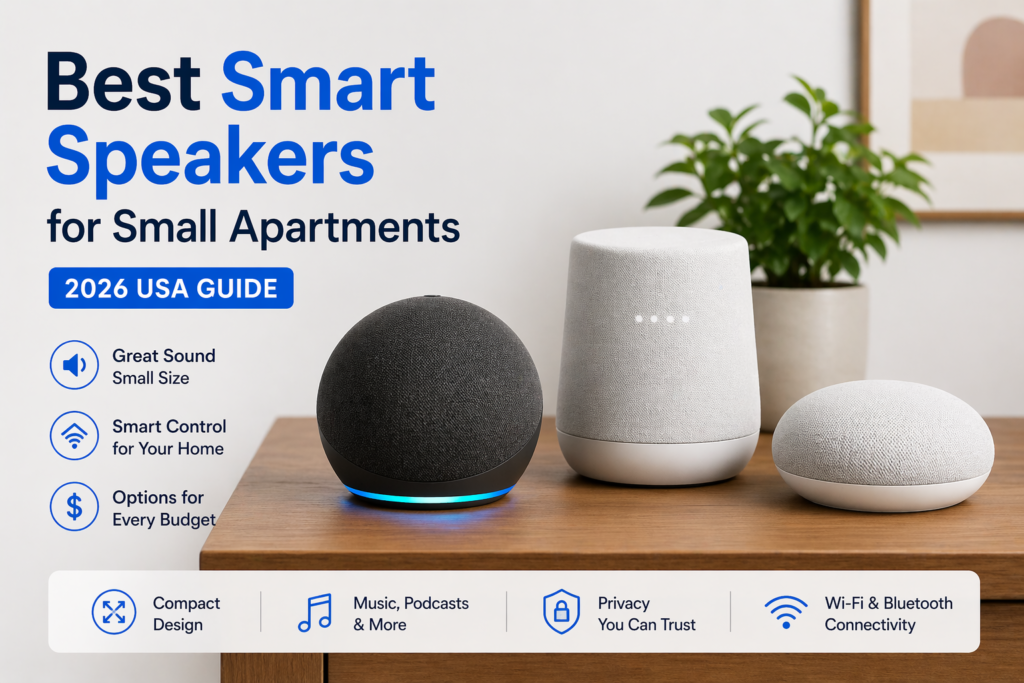
Best smart speakers for small apartments are becoming a must-have for modern life in 2026. There is no reason to give up on smart home technology because you live in a small apartment. Quite the contrary, in some ways, a smart speaker may be the best device you could purchase for your compact apartment since every year they become increasingly smart, compact, and high-quality.
The rising interest in using smart speakers in small apartments is not surprising at all. They are compact and very functional – with the help of such a device, you can control your light, choose the playlist for your party, put timers to cook meals, and even fall asleep thanks to its white noise. The thing is, you need to choose the one that has good sound but occupies minimum space on your shelves or counters.
The Amazon Echo Dot (5th Gen) and Google Nest Mini (2nd Gen), among others, got the equation right with regards to how compact the device needs to be while maintaining decent audio fidelity despite their small form factor.
This guide will explore all the things that one needs to take into consideration when purchasing a smart speaker for a small apartment in relation to budget, sound quality, features, and more.
Table of Contents
Why Smart Speakers Are Perfect for Small Apartments
With the lack of space, each device must justify its presence. Indeed, there is nothing more suitable in terms of space than a smart speaker, and that’s why it is ideal for small apartments.
Space-saving compact design is one of the key features of any smart speaker. In other words, the majority of modern devices are created in such a way so as to take up minimal space. For example, you can put an Echo Dot somewhere on your bookshelf or Google Nest Mini on your bedside table. Besides, they do not need to have a designated place like most of electronic devices.
Voice control convenience is more evident when the size of apartment is small. That is because while cooking in the kitchen you can ask Alexa to set a timer of 15 minutes without using your hands which are covered in flour. The same applies to turning off the lights without leaving your comfy bed.
This multifunctionality comes into play when it comes to compact places. The functionality of your alexa speaker is not only to play music; it also acts as an alarm clock, weather forecast, shopping list generator, and smart home controller among other functions. Rather than buying different gadgets for each function, one google smart speaker would be enough.
The good thing is that there are affordable versions that allow everyone to benefit from such innovations. You can find a decently functioning smart speaker for less than $50 which is cheaper compared to getting different gadgets to do all the jobs done by a smart speaker.
What to Look for in a Smart Speaker for Small Spaces
To find the best smart speaker for your apartment, one needs to consider numerous factors. I will list those factors that need to be taken into account.
Size & Design is the first factor that needs to be considered. It would be necessary to measure the spots in the apartment where you can place the device – a shelf, bedside table, and a countertop in your kitchen. Smart speakers come in various sizes, which, however, are usually relatively small. There are tall and cylindrical, short and wide, and even flat speakers on the market.
Sound Quality in Small Rooms is somewhat different from that in larger space. In an apartment, there is no need for large-volume speakers and loud bass, which could disturb neighbors. However, a good sound quality in terms of clear vocals is important. In fact, it turns out that small speakers work better in smaller rooms, as the sound does not have to cover much distance.
Wi-Fi & Bluetooth Connectivity is very important as these features provide the major functions of a smart speaker. It is essential that the speaker supports your Wi-Fi network. Bluetooth is a good backup solution and can be used by guests to play music easily.
Voice Assistant choice – Alexa vs Google Assistant – is mostly dependent on which devices and services you currently use. Google services like Gmail, Google Calendar, Google Photos, etc., will work better with Google Assistant, while Alexa may suit someone who uses many Amazon products and shops on Amazon often.
Privacy Features are critical now due to the small spaces smart speakers are used in. The best solution is to have a physical mute button and visual indication when the microphone is active. Both Amazon and Google have greatly advanced in improving privacy options in their products.
Budget considerations for a smart speaker for apartment use varies between $20-$100. The optimal price range for a smart speaker for apartment use lies somewhere between $30-$50. This is where you will get great quality of the product and all the necessary functions without paying extra money for additional audio components you won’t really need.
Best Smart Speakers for Small Apartments (2026 Picks)
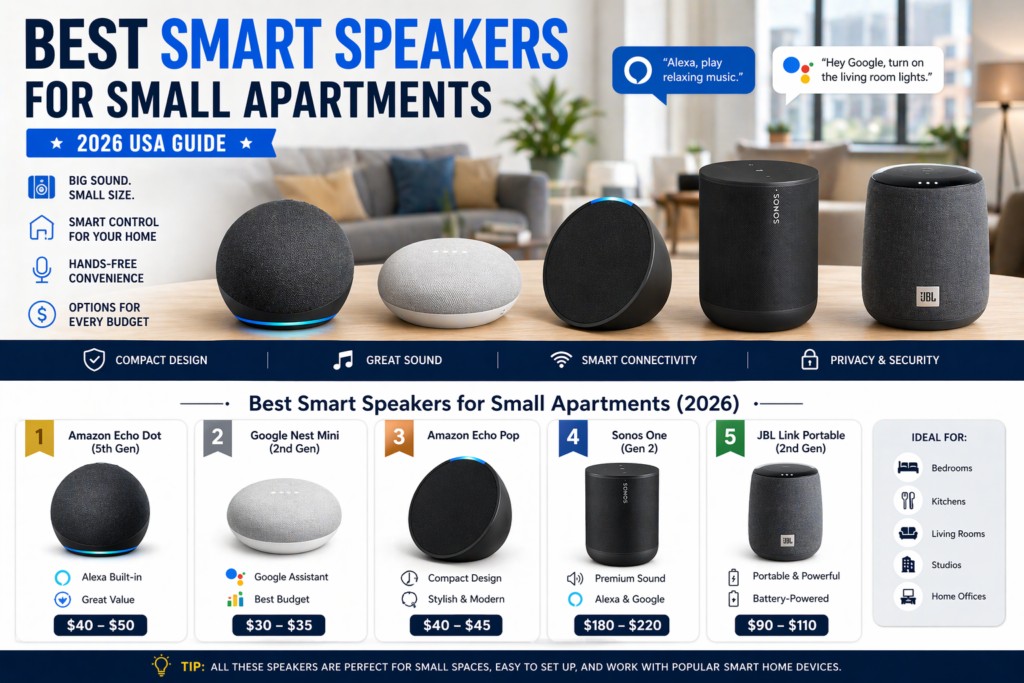
After comparing a wide range of options, here are the best smart speakers for small apartments, selected based on size, sound quality, smart features, and overall value.
🥇1. Amazon Echo Dot (5th Gen) – Best Overall
Price: ~$40–50
Echo Dot remains one of the best choices for small apartments. Amazon got everything right with this generation of its product.
✔️Pros:
- Stylish compact design suitable for almost any place
- Good bass for such a small gadget
- Access to the vast Alexa ecosystem
- Displays time, weather conditions, and other information via LED
- Option to connect external speakers if needed
- Very accurate voice recognition even in noisier surroundings
❌Cons:
- No built-in battery (needs to stay plugged in)/No internal battery
- Can get confused by very loud music requests
Best for: Anyone already using services provided by Amazon or someone who wants maximum control over smart home devices. In terms of maturity and ability to operate with different devices, the Alexa ecosystem beats competitors.
5th Gen Echo Dot is great for daily kitchen use: you can set timers for cooking, play music or ask questions quickly. Sound quality is okay for background music and voice responses but it’s not intended to replace your speaker.
🥈2. Google Nest Mini (2nd Gen) – Best Budget
Price: ~$30–50
The Nest Mini is a fantastic choice for budget-minded consumers or users heavily relying on Google’s services.
✔️Pros:
- Affordable way to enter the smart speaker world
- Superb voice recognition of Google Assistant
- Smooth integration with Google services
- It can be wall-mounted, hence not occupying counter space
- Good sound quality at the price range
❌Cons:
- Bass is relatively good
- Small ecosystem compared to Alexa
- No screen/display (only LED lights)
Best for: Budget-minded consumers and those utilizing Google services. If you spend your time in Google Photos, use Google Calendar all the time and need Google search at hand, then here is your speaker.
The voice recognition of the Echo Dot is quite superb for routine command execution even if you aren’t standing right by the device. Being priced at $30, the speaker is a decent value in terms of affordability and voice responsiveness.
“The Google Nest Mini is available on the official Google Store”
🥉3. Amazon Echo Pop – Best Compact Design
Price: ~$40
The latest addition from Amazon in the Echo series is all about design and super compact size.
✔️Pros:
- Ultra-compact size – seriously compact
- Modern and sleek design in various colors
- All essential features of Alexa covered
- Good for bedroom or extremely compact space
❌Cons:
- Less overall sound output compared to Echo Dot
- No display features available
- Insufficient bass range
Best for: Stylish customers looking for design-oriented and extremely compact space. Great for bedrooms and desks.
“Check all Echo devices on Amazon”
🎵4. Sonos One (Gen 2) – Best Sound Quality
Price: ~$180–220
Sure, it is much pricier, but when sound quality is your main concern, the Sonos One is leagues ahead of any other speaker.
✔️Pros:
- Premium sound quality that rivals much larger speakers
- Supports both Alexa AND Google Assistant
- Can pair with other Sonos speakers
- Regular software updates and improvements
- Touch controls on top
❌Cons:
- Much higher price point
- Larger footprint than budget options
- Might be overkill for very small apartments
Best for: Audio enthusiasts willing to pay more for premium sound, or anyone planning to build a multi-room audio system over time.
The Echo Dot provides solid sound quality for small apartments, while more expensive smart speakers can offer noticeably better audio. For most users, however, the additional cost may not be worthwhile unless sound quality is a top priority.
“Premium sound options like Sonos are also worth considering”
🔋5. JBL Link Portable – Best Portable Option
Price: ~$90–120
The only battery-operated speaker on the list and hence, extremely flexible for an apartment dweller.
✔️Pros:
- Built-in battery lasts 8+ hours
- Great for moving between rooms
- Solid JBL sound quality
- Google Assistant built-in
- Can work as a regular Bluetooth speaker too
❌Cons:
- More expensive than plug-in alternatives
- Battery eventually degrades
- Larger than most compact options
Best for: Frequent movers or those who need a portable speaker that can be moved around the house.
Comparison Table
Here’s a quick reference to help you compare these top options:
| Device | Price | Assistant | Best For | Key Feature |
|---|---|---|---|---|
| Amazon Echo Dot (5th Gen) | $40–50 | Alexa | Overall winner | Best feature balance |
| Google Nest Mini (2nd Gen) | $30–50 | Google Assistant | Budget buyers | Lowest price |
| Amazon Echo Pop | $40 | Alexa | Style-focused | Ultra-compact design |
| Sonos One (Gen 2) | $180–220 | Alexa/Google | Audio quality | Premium sound |
| JBL Link Portable | $90–120 | Google Assistant | Portability | Battery powered |
The Amazon Echo Dot (5th Gen) tops the charts since it provides the best combination of price, features, and performance. However, depending on your requirements, such as having to pay the least amount of money or getting the best audio quality, other devices could work out just fine for you.
Alexa vs Google Assistant (Small Apartment Use)
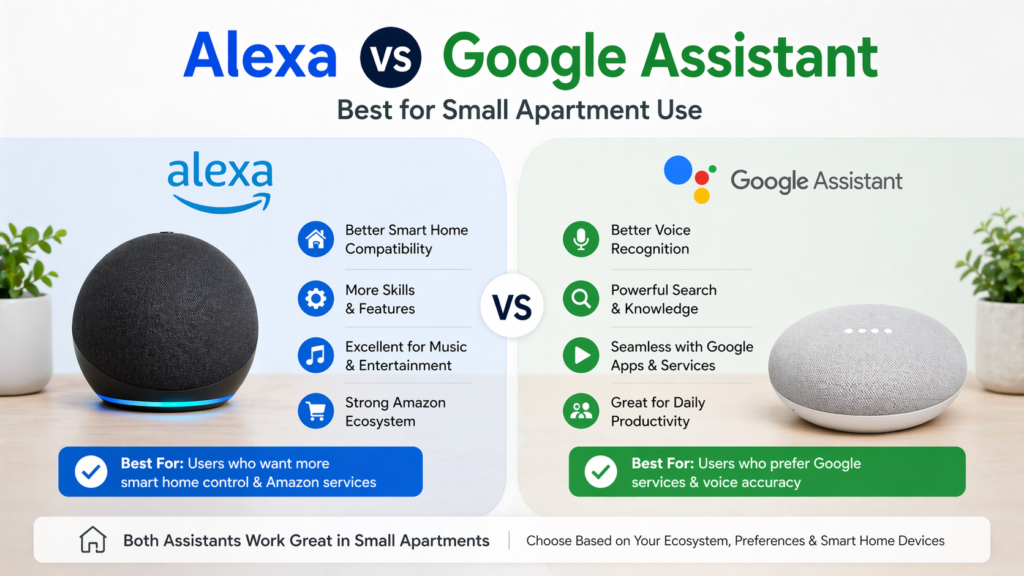
There is an actual rivalry going on between amazon alexa and google assistant, and it can affect your life greatly. Allow me to show you what I mean by that using the small apartment example.
🔵Alexa (Amazon) advantages:
- Better compatibility of smart home gadgets – trust me, it’s not even close
- More “skills” (integrations with third parties) available
- Better shopping integration if you buy through Amazon
- Better synchronization of multiple gadgets if you add more Echo gadgets
- More natural language flow when asking follow-up questions
🟢Google Assistant advantages:
- Much better speech recognition even if you speak with an accent
- Better overall knowledge and search abilities
- Better integration with Google products (Gmail, Calendar, Photos)
- More natural-sounding voice
- Better understanding of complex questions and context
In case of small apartments, I will choose Alexa because it is more important to control the smart home when there is less space available. Voice command for controlling the lights, plugs, and other devices plays an important role in the case of a studio apartment compared to a big house when one can easily walk to the switch and turn it on.
Nevertheless, if one does not have any intentions of using smart home devices but wants to get music, weather forecast, and answer other questions, then superior voice recognition and search abilities of Google Assistant might be a better choice for the user.
The choice between alexa vs google often depends on the ecosystem that one has created till now. One should check which services one uses regularly and accordingly go for an assistant.
Best Use Cases in Small Apartments
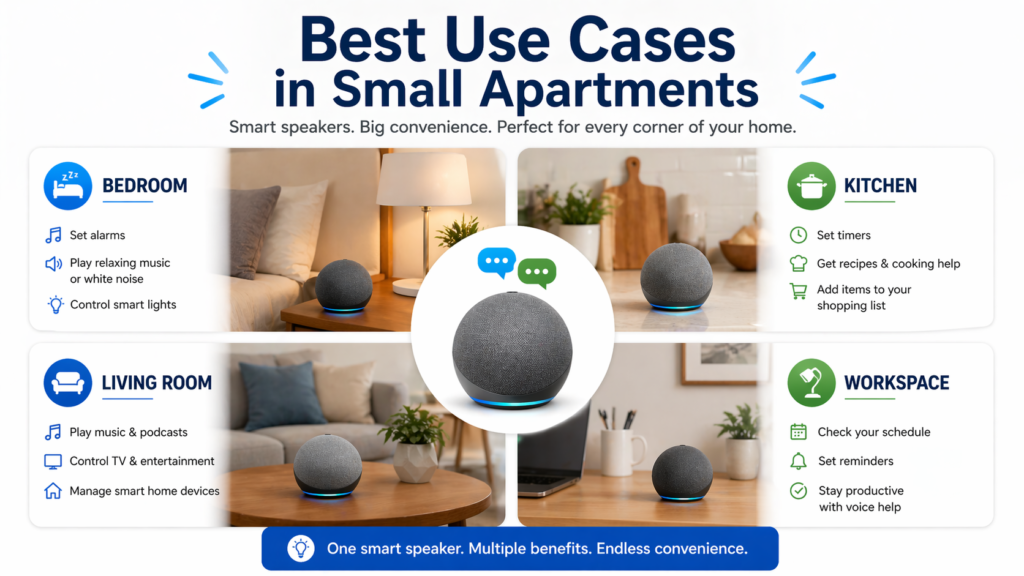
The smart speaker devices work best in certain cases within apartments. The following are the case scenarios where I found them most useful:
🛏️Bedroom alarm & music setting case scenario is best because you can have several alarms through voice command. You can also check the weather during dressing and play background music. I have completely replaced my old alarm clock.
🍽️Kitchen timers & recipes case scenario could be the most useful everyday usage. This is due to the fact that while cooking in the limited kitchen, having the ability to use the timers and checking measurements becomes very useful.
🛋️Living room smart control becomes very important in smaller rooms when the light switches are not easily reachable, and there is a need to change the lighting depending on the task without moving.
💡Smart lighting automation will help increase space and comfort of living in a small apartment. The programming of gradual brightening of lights in the morning and darkening of the lights in the evening creates different “zones” of living in the studio.
It is important to start from some specific cases of use and not to automate all functions at once. Choose those cases which will really simplify your life.
Common Problems & Fixes
The best smart speakers may encounter difficulties too, particularly in apartments, where Wi-Fi connectivity issues might arise due to the possibility of interference and congestion.
📶WiFi disconnect issues are very typical. They normally happen due to either low signal strength or network congestion in adjacent flats. You should try relocating the router or replacing it with a mesh network system, in case you experience dead zones.
🎵Low volume problems is quite often an effect of incorrect placing of the speaker, which is done too close to a corner or a wall. It would be better to move the speaker at least a few inches away from any wall.
🎙️Voice recognition issues might be quite unpleasant but can be easily solved. First of all, check whether there are no obstacles in front of the microphone, try retraining the device for voice recognition, and make sure that there are not too many sounds around you. Sometimes just rebooting is enough to fix voice recognition issues.
Most of the problems encountered with the smart speakers are in fact quite basic and related to improper placement of the device.
Tips to Get Best Sound in Small Rooms
Small rooms have their own kind of acoustics, which you can play to instead of fighting against them. These are tips to improve your smart speaker’s sound:
Place speakers near walls (but not in corners) This will allow you to get bass boost from the wall without making the sound muddy. You should be able to find a comfortable distance of about 12 to 18 inches from the wall.
Avoid clutter Clutter like books and decorations can interfere with the sound in unpredictable ways. Let your speaker breathe some air.
Adjust EQ settings Use sound modes if your speaker has such features. Many speakers have several EQ settings and sound modes depending on the use and the type of the room. Play around with it – what works great in a spacious room may be too much bass in a small apartment.
Consider the height Also pay attention to the height of your speaker placement. Speakers placed at ear level are going to sound better than the ones placed really
❓FAQs
Q1. What is the best smart speaker for small apartments?
Echo Dot (5th Gen) is the optimal choice for me. This speaker has the best size, sound, features, and price ratio. Small size, good sound, and great Alexa smart home capabilities are its main advantages.
Q2. Are smart speakers worth it in apartments?
Absolutely yes. Smart speakers are actually more valuable in apartments than in larger homes because they maximize functionality in minimal space. You get music, smart home control, timers, alarms, and information access in one compact device. The voice control is especially helpful when space is tight.
Q3. Which is better Alexa or Google?
It depends on your existing ecosystem. Choose Alexa if you shop on Amazon, want the best smart home device compatibility, or plan to add more smart devices over time. Choose Google if you use Google services heavily (Gmail, Calendar, Photos) or want the most accurate voice recognition and search capabilities.
Q4. Do smart speakers need WiFi?
Yes, smart speakers need WiFi for their main functions like voice commands, streaming music, and smart home control. Some basic features like Bluetooth music playback might work without WiFi, but you’ll miss most of what makes these devices “smart.”
🔗Related Articles
- Google Home Setup Step-by-Step (2026 Guide for Google Nest, Mini & Smart Home Devices)
- Alexa vs Google Assistant: Smart Home Comparison
- Alexa Keeps Disconnecting? 12 Powerful Fixes That Work Instantly (2026 Guide)
- Amazon Echo Dot (5th Gen) Review (2026) – Is It Worth It?
- Google Nest Mini (2nd Gen) Review – Best Budget Smart Speaker? (2026)
- Best Smart Speakers Under $100 (2026) – Top Budget Picks That Actually Sound Good
- Best Bluetooth Speakers 2026: Shocking Smart Home Picks Under Budget
- Marshall Speaker Review for Smart Home Setup (2026): Worth the Premium Price?
- Hidden Features of Alexa You Didn’t Know (2026 Guide)
- Best Smart Speakers Without Subscription (2026)
🏁Final Verdict
After going through the list of tested speakers for the apartment in real life conditions, here are my final recommendations:
Overall best pick: Echo Dot (5th Gen) – The combination of dimensions, quality of sound, number of features and affordable price make this choice the smartest one for most of the apartment owners. The ecosystem of Alexa is reliable enough, and this speaker just works properly.
The best option for the budget-conscious buyer: Nest Mini – It costs only $30 that makes it an irreplaceable choice for those who look for affordable price. The quality of voice recognition by Google Assistant is high and if you are the user of Google products, everything will work like charm.
The best choice if you want the highest sound quality: Sonos One – In case audio quality is more important than price, Sonos One is a smart pick that provides premium audio in decently compact housing. Dual voice assistants are the extra feature.
Take into account all the factors mentioned above and choose the speaker which matches your apartment space, budget and ecosystem. Think about the purpose of the device in the most effective way without buying unnecessary features.
Any of these smart speakers will definitely enhance your experience in small apartment.
Pingback: Amazon Alexa Not Responding? 12 Proven Fixes That Work Instantly (2026 Guide for Echo Dot & Echo Show)