
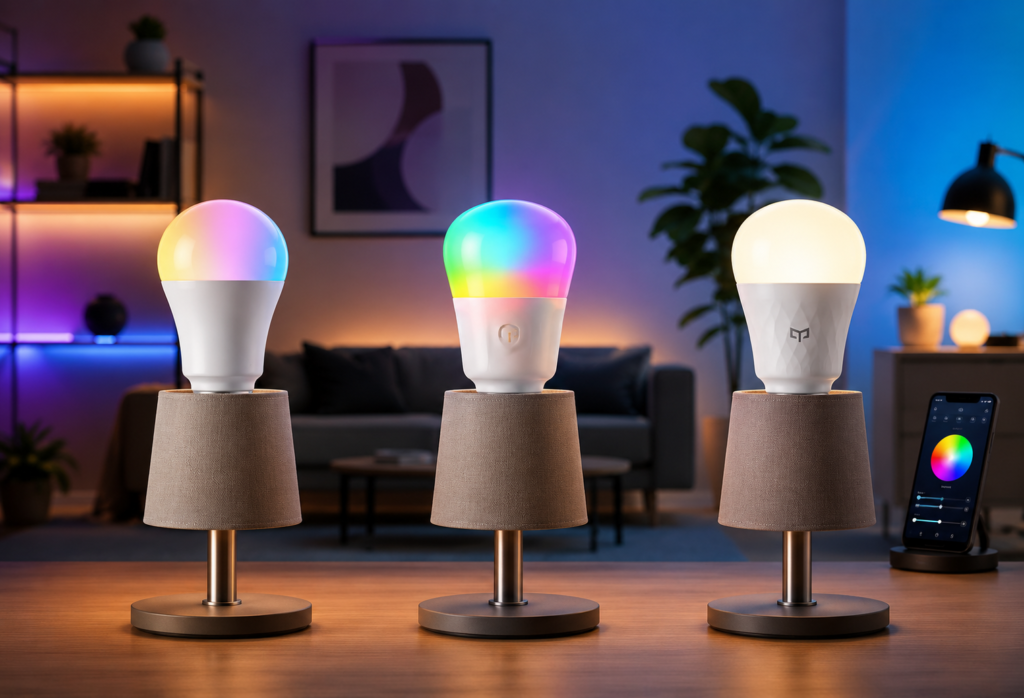
Philips Hue vs LIFX vs TP-Link Kasa Smart lighting have been gaining massive popularity in 2026, and there is a reason behind it. Having experimented with various types of bulbs for months, I can confidently say that smart bulbs are more convenient than traditional light switches. Be it adjusting the light at night in bed or creating ambiance for movies – smart bulbs make all the difference!
Among the best smart bulbs 2026 can offer, Philips Hue, LIFX, and TP-Link Kasa are the leading brands. They serve distinct audiences and cater to different price points. Philips Hue caters to consumers who seek a premium experience within their smart homes. LIFX appeals to consumers who look for the brightest light and the most vivid color displays. TP-Link Kasa is suitable for budget-conscious customers who still desire quality from their products.
The following comparison guide between Philips Hue, LIFX, and Kasa is intended to assist you in making an informed decision. The comparison is not meant to point to a single winning brand, but to a particular brand that suits your requirements.
Table of Contents
Quick Comparison Table
| Problem | Possible Cause | Quick Fix |
|---|---|---|
| Alexa says “device unresponsive” | WiFi issue | Restart router and smart bulb |
| Lights not showing in Alexa | Sync problem | Rediscover devices |
| Alexa controls some lights only | Group setup issue | Recreate room groups |
| Voice commands not working | Wrong light names | Rename devices clearly |
| Smart bulb offline | Weak connection | Move router closer |
| Delayed response | Network congestion | Use 2.4GHz WiFi |
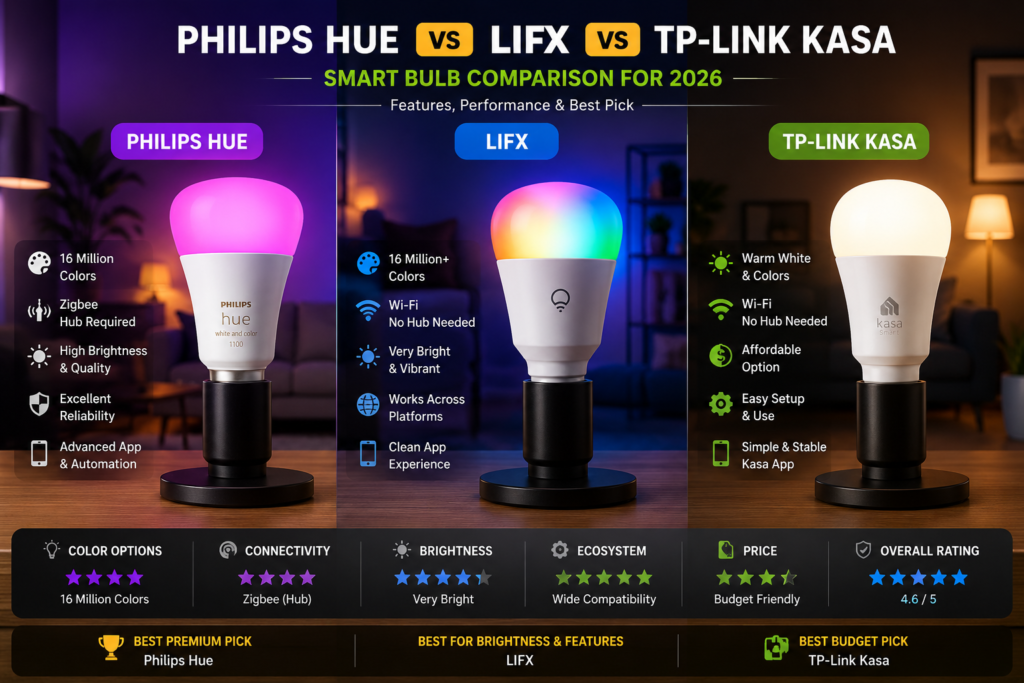
The comparison of these smart lights highlights the unique features of each brand. While Philips Hue provides you with the most comprehensive system, it does come with a cost. If brightness is a necessity for you, then go with LIFX, which comes with the brightest lights but doesn’t need any hub to connect to. The Kasa is an affordable option as well.
Philips Hue Overview
Phillips Hue falls into the category of high-end smart lighting solutions. Having used the Phillips Hue light bulbs for more than two years, I can assert with confidence that Phillips has created the most complete smart lighting environment. The Philips Hue bulbs are not only smart bulbs but rather a part of a system comprising various devices such as strips, outdoor lighting solutions, motion sensors, and smart switches.
While the process of setting up the Hue Bridge seemed like additional labor at first, now it is my favorite part. The fact that the bulbs operate using both Zigbee and Bluetooth technologies makes them respond immediately to any command, unlike WiFi bulbs which experience lag during high internet traffic periods.
Color accuracy makes Hue different from its rivals. Setting warm white lights will really make me feel as if there is a flickering candle light around me. Hue’s movie night entertainment sync feature makes movie watching very exciting, as the lights turn to the same color that matches what is being shown in the film. It seems silly at first, but watching action films with lights turning according to the film made the experience quite immersive.
It’s still easy to customize Hue with third party apps such as SmartThings, HomeAssistant, or Apple HomeKit, and the Hue app still gives users the best experience.
Best premium smart bulbs with great features require a high price tag, which is delivered by Hue lights. Their durability in the long term makes them worth every penny paid. Personally, my Hue bulbs have been working without any issues for over three years now. Although the initial cost hurts, the system only gets bigger from there on out.
Learn more on the official Philips Hue website
LIFX Overview
But the LIFX smart bulbs use a different strategy, focusing solely on being the best bulbs in terms of their brightness and great color capabilities.No hub installation method ensures simplicity in set-up; simply download the application, scan the QR code printed on each individual lightbulb and it is all done! It is important to note here that the WiFi smart lights approach will lead to having less devices, but your home WiFi network might be busier.
Color rendering is certainly worthy of note. LIFX light bulbs offer one of the brightest color displays I have seen when it comes to smart lights. Blues look very deep without appearing too washed-out, like other competitors. Reds are especially stunning and would be great for mood or gaming purposes.
The LIFX app provides excellent features with no unnecessary complexities. Scene-making is done effortlessly while the schedule feature manages daily tasks easily. Features that sync music are enjoyable during parties although they lag behind those of Philips Hue which syncs entertainments better.
Gaming players love LIFX bulbs. The lights’ brightness and saturation give them immersive effects either from sound effects from games or manually depending on gaming atmosphere desired. Features for screen mirroring operate well with PCs.
However, WiFi connectivity creates occasional challenges. Lack of internet connectivity makes certain features inactive. WiFi congestion may affect responses, but this hardly ever occurs in modern routers.
Visit the official LIFX website
TP-Link Kasa Overview
TP-Link Kasa Smart Bulbs show how affordable smart lights can be. These lights prioritize providing simple and dependable smart lights in an affordable manner.
Direct WiFi connection makes the lights work without any hubs or unstable connections. They can be installed by simply scanning a QR code and connecting to the internet in just a few minutes. Affordable smart bulbs shouldn’t be too complex to install, which Kasa achieves easily.
The everyday usability of Kasa smart lights cannot be faulted. Dimming is efficient, scheduling works reliably, and the response time to voice commands via Alexa or Google Assistant is very prompt. The app design favors simplicity over more sophisticated functionalities and is ideal for those who desire smart lighting without complexities.
The voice assistant compatibility of Kasa smart lights is exceptional, especially when considering the Kasa bulbs. The Amazon Alexa compatibility of these bulbs is excellent as they react promptly to voice commands without having to repeat them. Equally good is the Google Assistant compatibility.
Kasa offers color choices for its lamps, but none as striking as those offered by LIFX and Philips Hue. The quality is enough to satisfy mood lighting requirements. Temperature changes are perfect for daily activities where bright light promotes productivity during the day, and warm colors relax in the evening.
Value is undoubtedly one of the best things about Kasa. Multiple rooms can be equipped for the price of several expensive bulbs from competing manufacturers.
Explore TP-Link Kasa smart lighting
Philips Hue vs LIFX vs TP-Link Kasa: Feature Comparison
Brightness
Lumens from Hue and LIFX are different too. LIFX is the most luminescent smart light bulb and is recommended for big-sized rooms since it produces enough brightness to fill any space with light. During testing, LIFX lighted up my 400 square foot room with no extra lighting.
On the other hand, Philips Hue provides enough brightness to be used in most household settings but not in very big rooms. It is focused more on color quality than brightness.
The light produced by kasa bulbs is sufficient for small rooms. Even though they cannot be used to substitute high wattage bulbs in large areas, they do well with normal household lighting.
Color Accuracy
Phillips Hue leads in the test for color accuracy. With “sunset orange,” the bulb renders colors that truly mimic natural sunsets. Such accuracy is very important in photography or the presentation of artwork or any other situation requiring color accuracy.
LIFX focuses more on rendering saturated rather than accurate colors. The effect looks bright and lively, making it ideal for fun lighting or entertainment. However, sometimes it lacks accuracy although it makes an eye-catching sight for parties or gaming.
For basic color functionalities, Kasa fits well for ordinary users. Professional color quality is not guaranteed but satisfactory for changing room atmospheres or when watching sports matches to match team colors.
Connectivity
Zigbee connection with Philips Hue provides the best connectivity. Commands are always executed in real time even if there are dozens of connected devices. The mesh network becomes even better as the number of Zigbee-connected devices increases.
WiFi connectivity provided by both LIFX and Kasa is quite good but has difficulties if there is too much traffic on the network. I have noticed that response time becomes slower if my relatives start streaming videos while controlling smart bulbs.
Smart Home Compatibility
Integration with all voice assistants is available among all three companies, yet to different extents. Philips Hue gives the deepest integration with smart homes, featuring such options as motion sensing, entertainment, and other advanced functionalities.
The LIFX lighting is well integrated with many platforms, being independent of hubs, which allows accessing lights remotely using only internet access. However, integration with popular smart home assistants is not offered by LIFX.
As far as Kasa is concerned, this brand supports popular platforms (Alexa, Google), providing good integration. While the advanced options are not supported, basic automation and voice control are excellent.
App Experience
Comparison of smart light bulbs features is done via the Philips Hue application. Customization of scenarios, the possibility to use advanced timers and automation, makes the process easy. The ability to simulate sunrise, sunset effects and vacation mode provides more useful functions.
The LIFX app is reliable and has advanced functions to create scenes and schedule events. Entertainment features such as syncing with music and mirror screens add up, but the interface appears less attractive compared to the Hue’s.
Kasa keeps the idea behind its application very simple. All basic functions including scenes creation and scheduling work perfectly without any problems. For those who want easy-to-use smart light bulbs, Kasa wins in all respects.
Performance & Reliability Test
Performance in different circumstances by these smart lights varies, with different results.
In testing of smart bulbs, Philips Hue is seen to be the smart light that shows consistent performance. Commands are performed in less than one second, while the connection remains very stable, and the smart bulbs show long-term reliability. I have not encountered any issues with Philips Hue smart bulbs losing their connection while working.
When the network is stable, LIFX bulbs show good performance. However, when there is network congestion, there will be some latency, with some commands taking up to 2-3 seconds before executing.
The Kasa bulbs surprisingly perform reliably, even as budget models. They are fast to respond each day, and voice control operations have never been a problem, though not quite as fast as the Hue but not a problem in practice.
Connection reliability is much better on Zigbee than WiFi. The Hue bulbs always retain their connection, even during router resets and power outages or other changes. WiFi models, on rare occasions, may require reconnecting to the new network after a network change.
Reliability test results after more than 18 months prove that all three types work fine. None have stopped working yet, though some WiFi problems occurred with LIFX and Kasa brands, requiring additional troubleshooting.
Best Smart Bulbs by Use Case
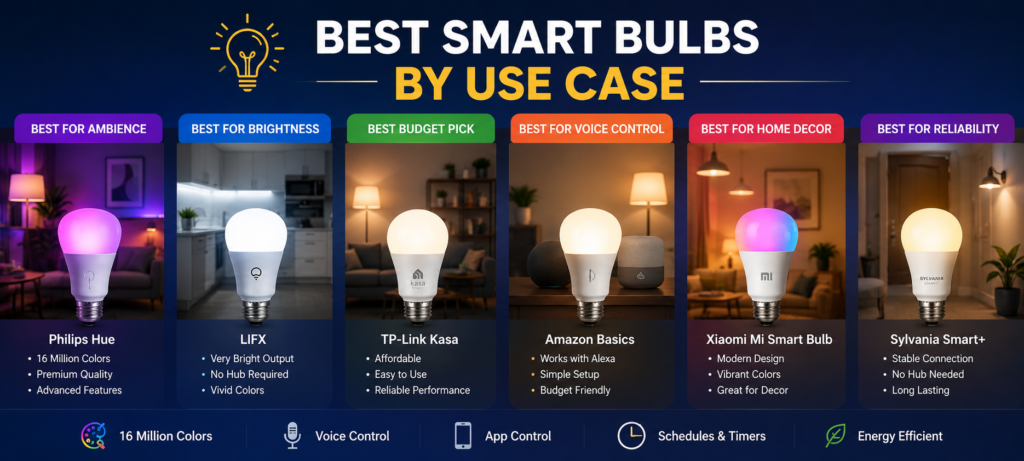
Best for Smart Home Enthusiasts → Philips Hue
It would be important for the people involved in automation systems to use such bulbs which could develop with the system. In this case the Hue technology stands head above other technologies.
Best for Bright Rooms & Gaming → LIFX
For larger spaces and gaming, one should choose lamps that provide bright illumination and rich colors. The top smart lamps for gaming must have screen synchronization functions and strong colors.
Best Budget Smart Lighting → TP-Link Kasa
Smart lighting from Kasa bulbs represents an excellent budget choice. It would be a mistake for a good smart bulb to demand significant expenses and a lot of configuration.
Best for Alexa Users → Kasa or Hue
The best choice of smart bulbs to use with Alexa will vary based on how complex you want your system to be. For easy connection and voice-controlled usage, Kasa is an excellent choice. Hue is more suitable for advanced Alexa functions.
Best for Apple HomeKit → Hue or LIFX
Apple users must look into Hue or LIFX products as they provide seamless HomeKit integration. Among these two, Hue provides better connectivity via HomeKit integration while LIFX bulbs have better brightness performance.
Best for Beginners → Kasa
The introduction of new smart homes requires reliable equipment. Kasa lights install easily, work flawlessly, and have everything a bulb can have in a smart home environment.
WiFi vs Zigbee Smart Bulbs
Understanding WiFi vs Zigbee smart bulbs helps explain performance differences between these brands.
WiFi Smart Bulbs
There are also some clear benefits to WiFi connection; there is no need for extra hubs, and people generally have knowledge about WiFi connections. With LIFX and Kasa smart bulbs, you only need an internet connection.
But having smart bulbs connected through WiFi can result in overcrowding due to increased connected devices on the network. The internet may sometimes go down, thereby disabling some cloud-based operations such as voice control and remote operation.
Zigbee Smart Bulbs
Zigbee uses the Hue Bridge but creates its own mesh network among other smart home devices. This way, there is no congestion on the WiFi network because communication between the devices will be faster and more efficient.
In fact, more Zigbee devices make the mesh network better. Bulbs used by Hue can act as repeaters to create several paths for communication.
Zigbee does not need any internet connection to work. This means that when there is an outage, it can still be controlled using the Hue application, even though some features cannot work anymore.
Common Problems & Fixes
Smart bulb troubleshooting reveals similar issues across all brands, though solutions vary slightly.
Bulbs Disconnecting
WiFi Bulbs can at times experience connection issues, particularly during router resets or upgrades in the network. Router resets normally fix temporary disconnection problems, while permanent disconnections are best fixed by making sure that the bulbs connect to 2.4Ghz networks, as 5Ghz networks do not allow for compatible connections.
On the other hand, Zigbee Bulbs have less connection problems, but placing the Hue Bridge close to the affected bulbs is recommended in order to create a more reliable connection system.
App Not Detecting Bulbs
New setups might have issues with device discovery. It is recommended that you connect your phone to the same WiFi network as your bulbs while setting up the installation. Turning off your 5GHz network temporarily could help.
To pair Hue bulbs, press the bridge button on your bulb when setting up. You need to hold the power button on LIFX and Kasa bulbs for 3-5 seconds during the setup process to put the bulb in pairing mode.
Voice Commands Not Responding
Voice command problems usually arise from issues with connecting your account. Fixing these problems will involve re-linking your accounts to the smart bulbs in your voice assistant application. It is best if you use short and clear names for your bulbs, for example, “bedroom light.”
Delayed Automation
Automation latency mostly shows network congestion or low signal strength. In the case of WiFi lights, moving the router to better spots or switching to WiFi 6 helps in minimizing delays. In Zigbee, automation delays point toward excess distance between lights and the central device.
Firmware updates are equally important for efficient automation. It is recommended that you turn on automatic updates through your device’s respective app.
Which Smart Bulb Brand Should You Buy?
Choosing the best smart bulb brand 2026 depends entirely on your specific needs, budget, and smart home goals.
Philips Hue – Best Overall Premium Ecosystem
Pick Philips Hue for a full-smart lighting experience. The initial investment will be justified in time thanks to its reliability, numerous options, and the potential for future developments. Those interested in creating an advanced smart home will find this technology attractive due to its integration possibilities.
LIFX – Best for Brightness and Colors
Choose LIFX if the highest brightness and colorful shades matter to you. LIFX’s brighter bulbs make the best choice for gamers and other entertainment lovers, as well as for people who have large living spaces. No-hub connectivity attracts users who wish to use strong smart bulbs.
TP-Link Kasa – Best Value and Beginner-Friendly Option
Choose Kasa for high quality smart lighting systems at affordable costs. Beginners to the world of smart homes will find all important aspects included without too much complication or unnecessary cost.
Simple Buyer Recommendations:
Small Apartment: Consider using Kasa bulbs for your primary rooms, followed by switching to LIFX bulbs or Hue bulbs as needed.
Small Apartment: Consider using Kasa bulbs for your primary rooms, followed by switching to LIFX bulbs or Hue bulbs as needed.
Gaming Room: The brightness and color quality required for gaming are delivered by LIFX bulbs. The ability to sync screens is worth the premium price.
Whole-Home Setup: For a whole home setup, Philips Hue presents the best platform available for smart lighting coverage.
Budget Smart Home: By choosing Kasa, we can have a fully functional smart lighting system in all the rooms without spending too much money.
❓FAQs
Is Philips Hue worth the price?
Indeed, if dependability, functionality, and ecosystem development matter to you. Hue outperforms in terms of performance and offers an ecosystem that allows for more sophisticated automation than what’s possible using individual smart bulbs alone. Less expensive solutions suffice for basic smart lighting requirements.
Are LIFX bulbs brighter than Hue?
Absolutely. The reason that I say that is because LIFX bulbs give off way more lumens than Hue bulbs do, which makes them perfect for bright spaces. On the other hand, Hue prioritizes color accuracy.
Does Kasa need a hub?
Not necessarily; they work directly with WiFi networks without the need of any other hub. It makes installation easier although each bulb will use some WiFi bandwidth.
Which smart bulbs work best with Alexa?
Kasa and Hue both are great when paired with Alexa. Kasa provides excellent base-level voice-control that works seamlessly well with Alexa commands, whereas Hue gives more advanced features including entertainment synchronization with Alexa commands.
Are WiFi smart bulbs reliable?
WiFi-based smart lamps are reliable, although not as reliable as their Zigbee counterparts. Internet network overload might create problems at times, and lack of access to internet can affect the cloud capabilities.
Which smart bulbs last longest?
LIFX, Kasa, and Hue bulbs all have approximately the same life expectancy of 15,000-25,000 hours based on regular use. From the perspective of construction, the Philips Hue might have an advantage; however, the differences are not drastic.
🔗Related Articles
- Smart Lighting System in the USA: Complete 2026 Buyer’s Guide
- How to Set Up Smart Lighting at Home (Step-by-Step Guide)
- 9 Best Smart LED Light Strips (2026 Review)
- Smart Lights Not Connecting? 10 Fixes That Work (2026 Guide)
- Gaming Room Smart Lighting Setup (RGB Guide 2026)
- Best Smart Lighting for Bedrooms (2026 Setup Ideas)
- Smart Lighting for Small Apartments (Budget Setup Guide 2026)
- Do Smart Lights Work Without Internet? (Explained Clearly)
💥Conclusion
The above comparative analysis shows that neither Philips Hue nor LIFX nor Kasa can claim dominance in the competition. Depending on your preference, you may choose one of the products because each of them is better at some things than others.
Philips Hue comes as the ideal smart bulb system for customers in need of the full ecosystem of features that come with high costs but bring about high performance and great opportunities for future development of the setup.
LIFX bulbs are ideal in terms of brightness and coloring capabilities and will be the best choice for entertainment lovers who need to brighten up the room for games and other activities.
Kasa makes the most economical option for smart lights, providing necessary capabilities at low-cost prices that make whole-house installation viable for almost everyone.
Your ultimate selection should be determined by the above considerations – your budget constraints, your needs regarding smart house capabilities, the space requirements in the rooms and the need for automation. You can begin with one room at a time before you proceed with whole-house installation.
The advantages of smart lighting convenience will be seen firsthand when you try the convenience of automated scheduling, voice controls and scenes management. Whatever the high-end Hue, the bright LIFX, or the low-budget Kasa light bulbs you go for, you won’t know how you got along with the conventional switches until now.