
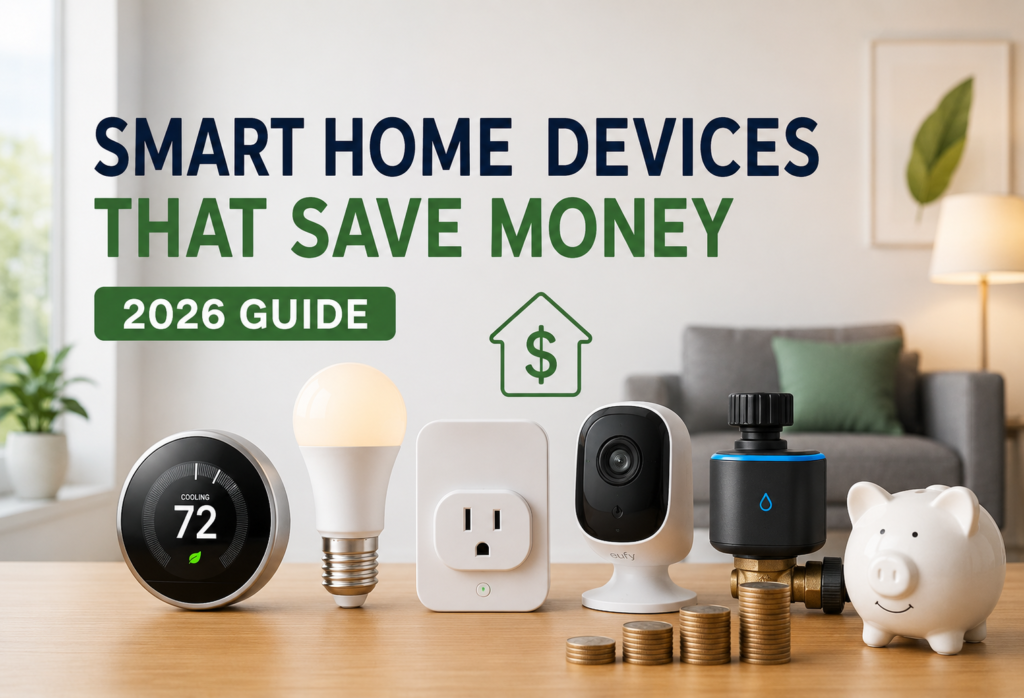
Smart Home Devices That Save Money can assist American families in conserving energy and managing household costs more effectively. Smart thermostats, plugs, energy monitors, smart lights, and other smart home devices can automate home appliances’ operation to ensure they work only when necessary.
Nevertheless, all smart devices may not necessarily lead to savings on your monthly bills. Usually, the largest savings can be achieved by selecting devices that tackle the largest areas of energy consumption at home and utilizing options like scheduling, automation, occupancy detection, and energy monitoring.
This guide offers you information about the best money-saving smart home devices of 2026, explains the way their savings are calculated, and shares important aspects of their functionality and mistakes to avoid.
Table of Contents
Do Smart Home Devices Really Save Money?
It might seem strange to think that buying smart home devices is the way to save money, but savings can be substantial if one buys right smart device.
Where Smart Home Technology Can Save
In general, savings can be achieved in the following areas:
- heating and cooling;
- lighting;
- standby consumption of electricity;
- water consumption;
- irrigation.
So, smart thermostats help regulate temperatures while homeowners sleep or when they are out, and smart outlets allow for automatic turn off of certain devices when they are not necessary to use.
Smart irrigation control allows for reduction of unnecessary watering because it works according to weather conditions and schedules.
How Automation Reduces Waste
The primary benefit provided by smart home is the automation function. You no longer have to remember to control the temperature or shut off light and appliances but can set up scheduling and routines for that.
Smart home technology can also help you determine which appliance uses the most electricity, so that you can know where you should take action.
Understanding Smart Home ROI
Not all smart home devices will be able to pay for themselves. You should take into account their cost, savings you expect from them annually, and payback period.
Let’s say that your $200 smart thermostat allows you to save $100 annually. In that case, its simple payback period will be two years, and then it will provide you with additional savings.
The optimal course of action would be to begin with smart home appliances that solve problems of your greatest expense areas in your house.
How We Chose the Best Money-Saving Smart Home Devices
We considered those devices that provide real savings and convenient automation instead of selecting products with numerous functions only.
Upfront Cost vs. Savings
We considered the upfront cost in relation to the possible annual savings and the period of the payback. A cheap but efficient device can be preferable for purchase to an expensive device that provides minimal savings.
Easy Installation
We paid special attention to devices that are easy to install without hiring a professional. The low price of the installation contributes to the faster payback.
Smart Home Compatibility
Devices that are compatible with Amazon Alexa, Google Home, or Apple Home will help to combine the routines and control energy usage.
Reliability
A money-saving device needs to work properly all the time. Reliability, feedback from customers, quality of app, and performance were taken into account during our research.
Realistic Savings
The estimate of the savings is provided according to the data of manufacturers, utilities, and average usage of devices in particular cases. Real savings depend on your house and energy rates, your energy consumption habits, and personal configuration of each device.
Quick Comparison Table – Smart Home Devices That Save Money
| Device Type | Average Cost | Estimated Annual Savings | Best For |
|---|---|---|---|
| Smart Thermostat | $150-300 | $130-180 | Homes with central air/heat |
| Smart Plugs (4-pack) | $25-50 | $50-80 | Electronics and small appliances |
| Smart Lighting Kit | $100-200 | $40-70 | Homes with frequent lighting use |
| Smart Power Strips | $30-60 | $30-50 | Home offices and entertainment centers |
| Leak Detectors (3-pack) | $60-120 | $0-2000+ | Prevention of catastrophic damage |
| Smart Irrigation Controller | $80-200 | $100-300 | Homes with automatic sprinklers |
| Smart Blinds (per window) | $200-400 | $20-40 | Large windows with sun exposure |
Below Is listed Smart Home Devices That Save Money
Smart Thermostats – The Biggest Money Saver
However, if there is a need to get a smart home device which will significantly reduce the costs of energy expenses, then the choice should be in favor of a smart thermostat.
Why Heating and Cooling Matter
It can happen that heating and cooling consume a big part of the energy costs, especially when the climate in the house area has either extremely hot or cold periods of time. Thus, controlling HVAC becomes a great chance to save energy expenses.
The traditional thermostat does not know when it is worth adjusting the temperature depending on the time of the day and the occupancy in the house. The smart thermostat can change the temperature settings depending on your habits.
How Smart Thermostats Save Energy
The ways smart thermostats save energy include the following features:
- Scheduling Adjustments based on schedules
- Geofencing Detection of your presence at home or absence using geofencing technology
- Learning features Customization based on your habits
- Energy reports Generation of energy-saving reports
- Remote control Control through a smartphone application
All these can help you feel comfortable while saving energy by running your HVAC system only when necessary.
How Much Can You Save?
It depends on the climate, HVAC, insulation, cost of energy, and thermostat setting. According to the EPA’s ENERGY STAR program, there is an estimation of the savings that you can achieve using programmable and smart thermostats, but individual savings will differ.
For instance, in case the cost of heating and cooling in your house is $1,200 per year, even if you reduce this cost by 10%, you will have savings of about $120 per year.
Best Smart Thermostats to Consider
Ecobee Smart Thermostat – Ideal for those whose homes would be greatly benefited by room sensors and occupancy-based temperature regulation.
Google Nest Thermostat – An excellent choice for people using Google products and wanting scheduling, remote control, and home automation features.
Honeywell Home Smart Thermostats – Excellent choices for those whose houses would require broad HVAC compatibility and easy-to-use controls.
Sensi Smart Thermostat – A great choice for those desiring basic scheduling, remote control, and HVAC compatibility.
Always ensure the compatibility of your HVAC system and the requirement of professional installation before buying any thermostat.
Smart thermostats can help homeowners manage heating and cooling more efficiently. ENERGY STAR provides information about certified smart thermostats and their potential energy-saving benefits.
Smart Plugs – Small Device, Big Savings
Smart plugs are cheap and can be used to eliminate wastage of power through automatic disconnection of selected devices that do not require power.
⚡ The Hidden Cost of Standby Power
Electronics keep using some power despite being switched off or on standby mode. TV, game console, computer, printer, and other connected gadgets can be examples of standby power users.
Amount of savings through elimination of standby power will depend on the type of devices you use, time in standby mode, and price of electricity per unit in your area.
Automate Appliances and Electronics
There is an option to automate the use of devices that have some repetitive use with smart plugs. This allows for:
- Turning off entertainment systems overnight
- Turning on and off decorative lights at fixed intervals
- Controlling fans and appliances
- Disconnection of specific devices once out of the house
- Checking the energy consumption of some models
This allows avoiding unplugging devices manually.
💰 Potential Savings
It all depends on the particular connected device and how much unnecessary runtime it utilizes. For instance, if the smart plug is controlling a few entertainment devices via a power strip, then it is likely to save more than the plug controlling a low-power lamp.
Models with an energy monitoring function can be helpful in finding out which devices use the most electricity and if it is worth automating.
Best Smart Plugs to Consider
TP-Link Kasa Smart Plug –A good quality product that features an easy app, scheduling, and energy monitoring on select models.
Amazon Smart Plug – An easy-to-set-up smart plug suitable for users of Alexa who prefer basic automation.
Meross Smart Plug – This plug has good smart home connectivity; some models feature Apple HomeKit, Alexa, and Google Assistant support.
Smart plugs should be used selectively. It’s better to concentrate on devices that use substantial amounts of energy or run unnecessarily.
Smart Lighting Systems
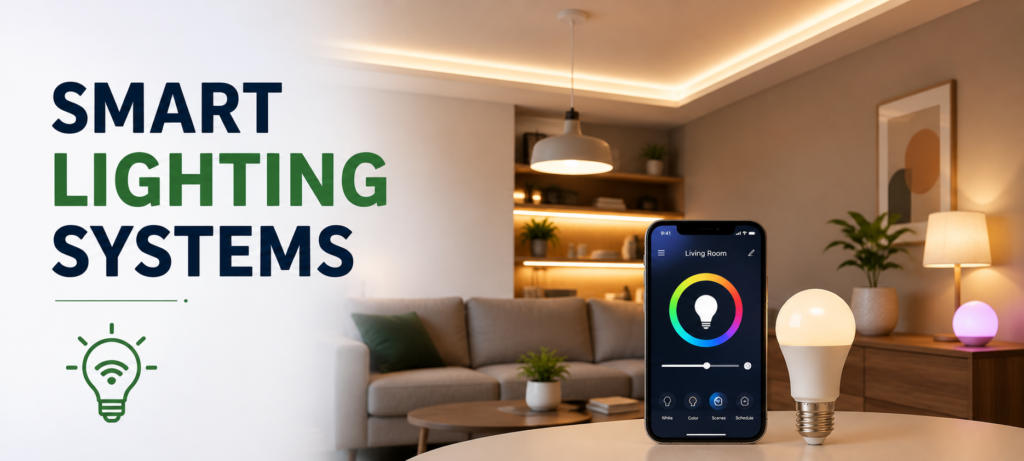
Energy-efficient lighting systems are easier to design since modern LED bulbs consume much less energy compared to old-fashioned incandescent bulbs. Smart lighting implies adding an automation component to reduce the usage of unnecessary light.
💡 How Smart Lighting Saves Energy
Smart LED light bulbs usually consume 75–80% less energy than regular bulbs and last significantly longer. The main savings happen when inefficient bulbs are replaced and there is a reduction in light on time.
Smart lighting options can also offer some extra savings due to the ability to:
- Turn the light off using automatic scheduling
- Dim light bulbs when their maximum brightness is not required
- Install motion sensors in places that are often overlooked
- Control lighting system remotely if you are not at home
- Use sunrise/sunset timing for scheduling purposes
Motion & Scheduling Automation
The automation feature of motion sensors works well in the bathroom, closet, hallway, and utility spaces because the light in those rooms is always left on inadvertently.
Light schedules can automate lights to be switched off when you go to sleep or even regulate the lighting based on sunrise and sunset to avoid wastage of energy.
LED Efficiency
For instance, changing an old-fashioned 60-watt incandescent bulb with a 9-watt LED one will help you save quite a bit of energy. Your savings will vary based on how many hours the light burns and the cost of power in your area.
Best Smart Lighting Options
Philips Hue – A high-end smart lighting ecosystem with advanced automation capabilities and color choices.
LIFX – Wi-Fi enabled smart lighting without any hub necessary, with great brightness and color capabilities.
TP-Link Kasa – An affordable choice for individuals looking for schedule management, remote operation, and compatibility with voice assistants.
In order to get maximum benefits, you should focus on replacing incandescent and halogen bulbs first..
Smart Power Strips
Smart power strips can help save on standby power when you have several electronics connected to one another in the same vicinity. They might be more convenient than using smart plugs.
Eliminate Standby Power
While regular power strips leave your electronics running on standby power, some smart strips will help turn off the power of those electronics after they’re no longer in use. More advanced strips will help turn off peripheral devices that go with the main device like computer or TV automatically once it’s been shut off.
Best Places to Use Them
Smart power strips work especially well in:
- Entertainment centers with TVs, consoles, streamers, and speakers
- Home offices with computers, monitors, printers, and other electronics
- Gaming setups Game station with multiple devices
Potential Savings
This depends on the amount of standby energy consumed by your gadgets and your electricity cost. The smart power bar will be useful where several appliances are left connected and powered while not being used.
The ideal application is to connect groups of electronics left on standby rather than gadgets which consume minimal energy.
Smart device Water Leak Detectors
While smart water leak sensors do not save you on your monthly billings, they can protect you from pricey water damages. Early detection is much more valuable for homeowners than the price of the sensor.
💧 Prevent Costly Water Damage
Damage to your home caused by pipe leaks, hot water tank failure, washer, dishwasher, toilet overflow, and many other potential water leaks may end up costing you a lot of money. Smart water leak sensors will alert you if the leakage starts.
Additionally, some devices monitor temperatures and alert you when freezing temperatures become a threat.
Insurance Benefits
Some insurance companies might provide discounts or benefits to homeowners whose houses have leak detectors that are approved. Nonetheless, not all insurance companies provide discounts or benefits for having leak detectors. Hence, you should consult your insurance company prior to making assumptions.
What to Look For
Choose leak detectors with:
- Smartphone alerts
- Loud local alarms
- Temperature detection
- A long-lasting battery
- Compatibility with several sensors
- Wi-Fi/smart home integration
Put the sensors close to the water heater, washing machine, sink, toilet, dishwasher, etc.
Smart Irrigation Controllers
Use of smart irrigation controllers may play an important role in reducing waste of water outdoors through scheduling watering depending on the weather, season, and needs of the lawn or garden.
💧 Why Smart Irrigation Helps
Older irrigation timers used a fixed schedule for watering regardless of whether there was rain or change in weather conditions. As a result, some extra watering took place especially after rain or during cooler weather.
Use of smart irrigation controllers makes it possible to skip watering during rains or based on weather change. Some smart irrigation systems make use of soil-moisture information as well.
Potential Water Savings
Water savings will be contingent on factors like your climate, landscaping needs, irrigation system, and how much you are currently over-watering.
Before purchasing the product, make sure the controller is compatible with your current irrigation system and the number of zones it offers.
Best Smart Irrigation Options
Rachio Smart Controller – Good choice when you need an advanced weather-based scheduling system, with multiple zones, and watering controls.
Orbit B-hyve – Nice option because of its app functionality, weather-based scheduling, and good price point.
To get the most out of your purchase, use the device along with proper sprinkler head adjustment and watering schedules.
Smart Blinds and Shades
Automated blinds and shades may help increase energy efficiency by controlling light and heat coming into your house. Automated blinds and shades would be especially effective for rooms that have big and sunny windows.
☀️ Reduce Winter Heating Demand
On sunny winter days, automated shades may open to let the sunlight heat up your rooms. Then in the evening, shades may close to create one more barrier that will prevent heat loss through the windows.
❄️ Reduce Summer Heat Gain
On summer days, automated shades may close when there is too much sun falling on your windows. This way, you can reduce heat gain in the house and thus reduce the workload on your air conditioning.
Windows that are facing south and west may need automated shading as they are exposed to strong afternoon sun.
Passive Energy Savings
Once programmed, smart shades will be able to do so automatically based on schedules, amount of sunlight, temperature levels, or any other sensors. This will eliminate the need for making adjustments all through the day.
Depending on the climate, orientation of the window, the kind of glass, insulation level, and other window treatments, the amount of energy savings will be different.
Because smart blinds tend to cost more than other energy-saving products, one needs to think about the energy saving potential and payback period.
Smart Energy Monitoring Systems
Knowledge is the key to cutting down your energy bills. These intelligent energy monitoring systems can help you find out where you are wasting energy and how you can cut back on those areas.
Identifying Energy-Hungry Appliances
Many homeowners are not sure which appliances and gadgets use up the most amount of electricity. Energy monitors that are smart will help you discover which appliance or gadget uses the most amount of energy.
You will be surprised at how much energy your old refrigerator uses up along with other gadgets like the water heater or other devices that have been turned off for a long time.
Whole-Home Energy Tracking
Whole-house monitors are installed at the electrical panel and monitor your entire house energy usage in real time. Monitoring gives you insight into how your household consumes energy and ways of optimization.
Utilities offer time-of-use pricing, where the price of electricity is higher during peak hours. Monitoring helps to plan usage during cheaper periods, thus saving you significant money every year.
Behavioral Changes That Save Money
Monitoring of your energy use makes you behave differently and be more energy efficient. Realizing how much money goes just on cooling your house makes you regulate temperature settings.
Gamification plays an important role with kids who are excited when they see energy savings in real time and feel good about themselves for turning off lights and unplugging gadgets.
Smart Home Security Devices That Save Money
Security systems can save you money through prevention of theft and damages that occur. They are worth more than their cost during their first year of use.
Preventing Theft and Property Loss
Americans lose billions each year due to theft and destruction of property. These systems prevent theft through presence of visible cameras and notifications sent out immediately upon detection of any suspicious activity. This is true even for a simple system.
It can make would-be criminals think twice before trying to steal from your home since it is difficult to get into a home under surveillance.
Insurance Discounts
A number of insurance companies provide discounts on houses with monitored security system installations. Insurance discounts vary from 5-20% of homeowners’ insurance premium.
Monitored security systems usually give bigger insurance discounts compared to self-monitored security. Nevertheless, even DIY security systems may be eligible for insurance benefits.
Remote Monitoring Benefits
Using smart home security systems gives the opportunity to make sure everything is fine with your house at any time you need, while you are away. With remote access you may be sure that doors are locked, check delivery packages and prevent possible security threats.
Smart Doorbells like (Nest Hello, Ring) protect the delivered packages and help to screen potential visitors. Every year package theft occurs in millions of houses in the USA, which makes a purchase of such camera worthwhile for almost all households.
Smart Locks save money on potential lockouts and allow to provide access to service people even if you are not present in the house.
Security Cameras give additional security by providing visual proof for insurance claims and assist in the recovery of stolen property. Installation of security cameras also acts as the deterrent to opportunist criminals.
Which Smart Home Device Saves the Most Money?
Considering money alone as a factor, the choice becomes obvious from the standpoint of how large the expense is that the device solves and how well it can save money.
Ranking Devices by ROI
| Device | Cost | Annual Savings | Payback Period |
|---|---|---|---|
| Smart Thermostat | $200 | $150 | 16 months |
| Smart Plugs (4-pack) | $40 | $70 | 7 months |
| Smart Irrigation Controller | $120 | $120 | 12 months |
| Smart Power Strip | $45 | $50 | 11 months |
| Smart Lighting Kit | $150 | $60 | 30 months |
| Smart Blinds (per window) | $300 | $30 | 120 months |
The most significant amount of money can be saved by the use of smart thermostats, whereas the fastest payback comes from the use of smart plugs. The most effective strategy would be to start using devices which have payback periods less than 18 months.
Best Smart Home Devices for Renters
There are certain factors that need to be taken into consideration when purchasing smart home devices if you are a renter.
Portable Smart Devices
Smart plugs, smart light bulbs that simply screw into the sockets, and smart speakers that are portable are great choices for renter. Such smart home devices do not require any wiring and installation and can be transferred to the new house with you.
The examples of battery-powered devices are smart leak detectors and wireless security cameras.
No-Wiring Solutions
Do not buy products like smart switches, wired thermostats, and others which require electrical installation. Use only plug-and-play and battery-operated products.
Smart power strips and plug-in smart outlets deliver the same function but do not require any changes to the structure of the property.
Budget-Friendly Options
Since you can rent the apartment, you need to be careful about what you buy and install because you will move away before getting your money back.
The cheapest solution is smart plugs and smart light bulbs.
Best Smart Home Devices for Homeowners
There is an ability to use more expensive smart home products with long-term periods of saving, because owners will live in one house long enough to obtain all possible profits from such devices.
Long-Term Investments
Such gadgets like smart thermostats, whole-home energy management system, smart sprinklers are ideal for people who are going to live in their houses for several years. Moreover, they start to save money more and more with time.
Installation of hard-wired smart switches and home security systems increases the value of a house, but at the same time brings saving from using these products.
Whole-Home Automation Savings
Homeowners have a possibility to build systems with integrated gadgets to save the most money. For instance, a smart thermostat may interact with smart window shades to achieve better results. And whole-home energy management system will cause automatic adjustment of another devices.
Such integration will take some planning and money but will give savings more than the individual savings from the devices themselves.
Highest ROI Devices
Among the devices that homeowners can purchase, smart thermostats are the best investment they can make. They come with a number of benefits including cost savings, among other features.
A smart irrigation system is also a great choice for those who have an automated sprinkler system.
Common Mistakes That Reduce Savings
There are many cases when people choose to install smart devices in their homes and yet fail to achieve their expected savings because of some mistakes that could easily have been avoided.
Buying Unnecessary Devices is the most frequent mistake homeowners make when choosing such devices. Even though some things like salt shakers and Wi-Fi-enabled toasters are interesting, they do not solve any of the expenses. Choose those devices that will help you reduce your biggest expenses.
Ignoring Automation Features is another thing that eliminates the whole purpose of purchasing smart devices. Manual usage of these devices does not bring any benefit since automated scheduling and learning would be more helpful.
Poor Placement can drastically reduce effectiveness. smart thermostats close to heat sources and places or leak detectors at wrong places so they do not work properly and fail to detect possible problems.
Not Using Energy Reports means ignoring the possibility to save extra energy and therefore more money.
Overcomplicating Your Setup means losing interest in your automation project. Start from the simple setup with a few devices.
Creating a Money-Saving Smart Home on a Budget
To create a budget-friendly smart home which will save your money does not imply making a huge one-time expense. A well-thought-out strategy can provide you with considerable savings without making substantial expenses at the start of building a money-saving smart home.
Start With Under $100
A simple money-saving smart home system starts from spending less than $100. Begin with a pack of 4 smart plugs ($40) and a smart thermostat ($60). These devices cover the two most significant sources of energy losses in houses.
These devices must bring you considerable savings to pay off their price within 6-12 months and buy new devices afterwards.
Build in Phases
Invest in a gradual way taking into account the savings from previously bought devices. In Phase 1 you deal with the problems of heating/cooling and phantom loads. In Phase 2, lighting and water management come in addition.
The phased method allows you to spread out costs over time and become familiar with the technology and individual device optimizations before becoming more complex.
Prioritize High-ROI Devices
Devices with High ROI First and foremost, you should always go for devices that have the potential to cut down your personal expenses. For instance, if your expenses related to cooling are high, you need to buy smart thermostats and window shades. In case you have expensive water sprinkling systems in your house, you need to buy irrigation controllers first.
Take Advantage of Rebates
A number of utility companies offer rebates on smart thermostats and other energy saving gadgets. In some cases, the rebate amount can be 50-100%.
Consult your local utility company, state energy office, and the federal tax credit programs before purchase.
❓FAQs
What smart home device saves the most money?
A smart thermostat can help you save a lot of money through automatic optimization of the temperature settings of heating and cooling depending on your schedule.
Are smart thermostats worth it?
This is true in homes that have high heating and cooling expenses. Before purchasing one, check the HVAC compatibility and utility rebates.
Do smart plugs reduce electricity bills?
Yes. By automatically turning off devices that are not in use, smart plugs can save you from unnecessary electricity usage.
Can smart lighting lower energy costs?
Yes. LED bulbs use less power compared to incandescent lights. Smart lighting can help save additional electricity because of scheduling, dimming, and motion automation.
How long does it take to recover the investment?
The time taken to pay back depends on the cost of the gadget purchased, its price, and how often it will be used.
Which smart home devices qualify for rebates?
Smart thermostats are common gadgets that qualify for utility rebates. Other energy-saving equipment also qualifies for rebates in some locations.
🔗Related Articles
- Best Smart Plugs 2026: Complete Buying Guide
- What Is a Smart Hub? Complete Guide for Beginners (2026)
- 9 Best Smart Bulbs in 2026 (USA Guide) – Top Smart Lights
- Smart Home Setup Under 200$ (2026 Budget Guide): Build a Smarter Home for Less
- 7 Best Smart Speakers Under $100 for Alexa & Google Assistant
- Best Smart Thermostat 2026 (Complete Buyer’s Guide)
- Smart Home Security Systems in 2026 (Expert Buyer’s Guide)
🔥Money-Saving Smart Home Final Verdict
🏆 Best Overall: Smart thermostats offer strong savings potential by optimizing heating and cooling.
💰 Best Budget Option: Smart plugs are inexpensive and easy to use for reducing unnecessary electricity consumption.
💧 Best for Water Savings: Smart irrigation controllers can reduce outdoor water waste through weather-based automation.
🏠 Best for Renters: Smart plugs and smart bulbs require little or no permanent installation and can move with you.
🏡 Best for Large Homes: Smart thermostats with room sensors can provide more targeted temperature control.
🚀Conclusion
The best money-saving smart home devices are those that target your biggest household expenses. Smart thermostats can optimize HVAC use, smart plugs can reduce unnecessary electricity consumption, and smart irrigation controllers can help limit wasted outdoor water.
Instead of buying an entire smart home system, start with one or two devices that address your biggest sources of waste. Track your usage and savings before expanding.
Focus on practical automation, measurable savings, and long-term value rather than flashy features. The right smart home devices can make your home more efficient while helping reduce unnecessary expenses.