
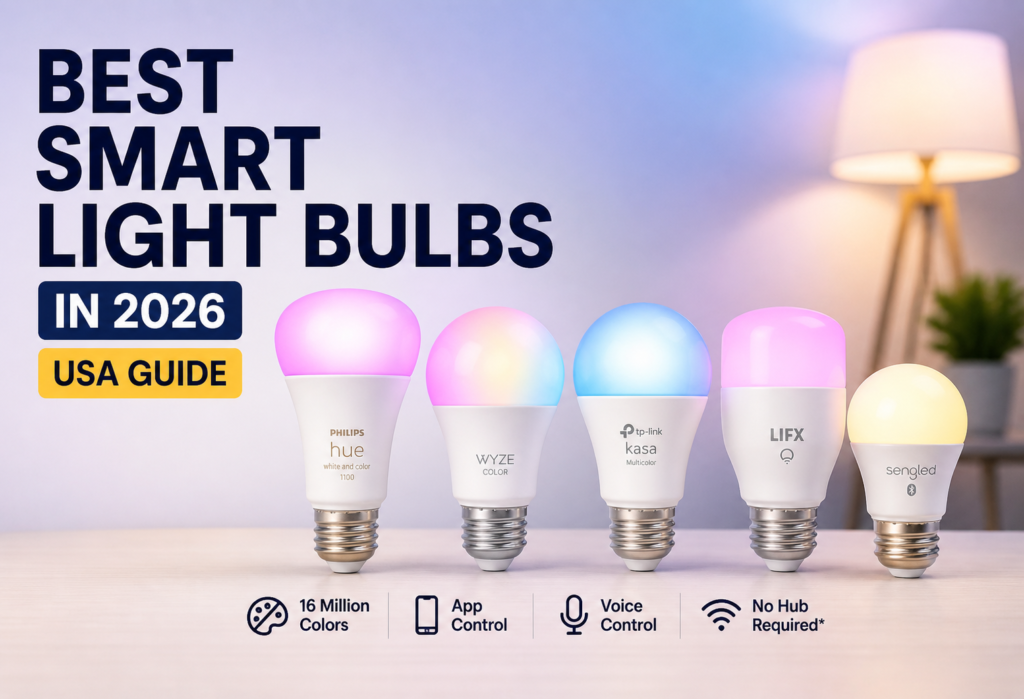
Smart lights have proven themselves as one of the most rapidly expanding automation categories in the year 2026, as over 78 percent of homes in America already own at least one such device. Should you feel like experimenting with smart home tech, smart bulbs will be the easiest way to get started because they simply go where the regular bulbs went no rewiring, no complicated setup.
It is hard not to be impressed by all the advantages of these products. It allows you to program a schedule that turns lights on prior to your arrival at home after a long day at work; make them change to a lower brightness for watching a movie using only your voice commands; and even switch them to flashing red if there is something suspicious captured on your security camera. Moreover, almost all of the best smart LED bulbs consume no more than 25% of the electricity usually used to light an ordinary bulb.
Table of Contents
Quick Comparison Table
Here’s a quick comparison of the best smart bulbs in 2026:
| Brand/Model | Price | Brightness (Lumens) | Colors | Connectivity | Best For |
|---|---|---|---|---|---|
| Philips Hue A19 | $49.99 | 800–1100 | 16M colors | Zigbee/Bluetooth | Premium experience |
| Wyze Bulb Color | $12.99 | 1100 | 16M colors | WiFi | Budget buyers |
| TP-Link Kasa KL125 | $19.99 | 800–1000 | 16M colors | WiFi | Best value |
| LIFX Color A19 | $54.99 | 1100 | 16M colors | WiFi | Brightness |
| Sengled Color Plus | $16.99 | 800–1100 | 16M colors | Zigbee | Alexa users |
| Feit Electric Smart Bulb | $24.99 | 800–1100 | 16M colors | WiFi | Easy retail availability |
| SYLVANIA Smart+ | $22.99 | 800–1000 | 16M colors | Zigbee/WiFi | Local store availability |
| Govee Smart Bulb | $15.99 | 800–900 | 16M colors | WiFi/Bluetooth | Gaming effects |
| Cync (GE) Smart Bulb | $26.99 | 800–1100 | 16M colors | WiFi/Bluetooth | Google users |
Budget options less than $20 have been clearly separated from premium options greater than $40 in the table below. Millions of color variations have become a norm for most bulbs today, contrary to a couple of years ago.
Top 9 Best Smart Bulbs in 2026
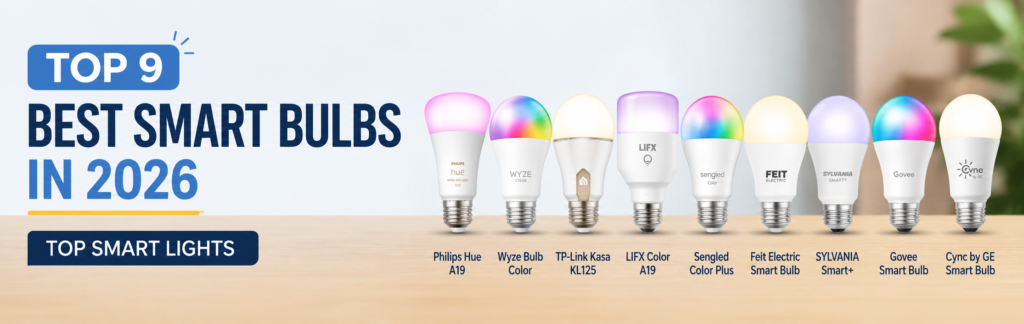
🥇Philips Hue Smart Bulb (Best Overall)
The Philips Hue continues to be considered as the best product for smart lights, and indeed, there’s a very good reason why it has maintained its position for all these years. The quality gap can be clearly felt from day one.
🔑Key Features:
- Maximum brightness of 1,600 lumens
- 16 million colors with excellent accuracy
- Connectivity with Zigbee and Hue Bridge
- Compatibility with all popular virtual assistants
- Scheduling and automated controls
- Music sync, movie and game sync
✅Pros :
- Color accuracy and brightness are amazing
- Reliability is guaranteed; fast reactions
- Best application available with many capabilities
- Wide ecosystem of compatible accessories
❌Cons:
- High initial cost
- Hue Bridge needed to use all functions
- Over-engineered for simple lighting tasks
This is where Hue really excels. The colors have an authentic look, the whites are bright but not harsh, and everything reacts instantaneously to any adjustment. Connectivity hasn’t been a problem.
Best for: Anyone who is looking for the best smart lighting experience money can buy. Great for entire home systems.
Final verdict: If you aren’t budget-conscious, this is the perfect smart lighting system of 2026.
“Best Smart Bulbs in 2026” Philips Hue Official Website
🥈Wyze Bulb Color (Best Budget)
With an asking price below $13, it is obvious that the Wyze Color light bulb demonstrates that it is unnecessary to invest large amounts of money to get high-quality smart bulbs.
🔑Key Features:
- 1,100 lumens of brightness
- 16 million colors of choice
- Connection via Wi-Fi (no hub required)
- Supports Alexa and Google Assistant
- Music synchronization capabilities and pre-set scenes
- Schedule and holiday modes
✅Pros:
- Best value for color light bulb
- Simple installation without needing a hub
- Bright enough for most rooms
- Decent colors and good colors accuracy
❌Cons:
- Sluggish at times
- Not many extra features
- Sometimes has connectivity issues
The performance of the lights is close to 80% of what high-end lightbulbs have to offer while being only 25% of the cost. They aren’t as bright as the Hue smart bulbs, and there can be 1-2 seconds of delay with voice controls, although that probably won’t affect most users.
Best for: Those who are buying smart light bulbs for the first time or people who rent.
Final verdict: An excellent way to enter the world of colored light bulbs. Just don’t expect top-tier performance like that of Hue lights.
🥉TP-Link Kasa Smart Bulb (Best Value)
The Kasa KL125 finds the perfect balance between affordability and features that makes it highly recommendable. It is priced at $20, it feels like you’re getting a $35 bulb.
🔑Key Features:
- 1,000 lumens with smooth dimming
- Full color spectrum with excellent color rendering
- WiFi connectivity with excellent connectivity
- Good mobile app
- Voice command and scheduling
- Away mode for security
✅Pros:
- Price-performance ratio is great.
- WiFi connectivity is stable.
- The app interface is user-friendly.
- Good Customer service at TP-Link is responsive.
❌Cons:
- Is not very bright.
- Certain colors seem washed out.
- It lacks any synchronization abilities.
This app is certainly one of the more impressive apps, not only does it run smoothly and almost never crash, but the color accuracy isn’t bad at all considering the low cost. Of course, there are no vibrant blue or purple hues to be seen.
Best for: Those individuals seeking a reliable smart bulb that has plenty of functionality without being top-notch.
Final verdict: The most versatile choice available for most families – reliable, affordable, and feature-rich.
🏅LIFX Color A19 (Best Brightness)
From its beginning, LIFX has made a point of creating the brightest smart lights available, and that trend continues with its 2026 model. If you’re looking for high brightness, here’s your lamp.
🔑Key Features:
- Max luminosity of 1,100 lumens
- High color saturation
- WiFi connectivity (without requiring a central hub)
- Advanced Effects and animations
- compatibility with all Platform
- Audio and screen synchronization
✅Pros:
- Most colorful in the market
- No need for hub
- Superb special effects
- Works wonders for spacious rooms
❌Cons:
- High-end price
- May become overpowering in small rooms
- Consumes more electricity
The colors are really gorgeous – true blue colors that don’t appear to be more purple than anything, and very vibrant red colors. The brightness allows the lighting to be used effectively in large living rooms and tall rooms.
Best for: large rooms, tall rooms, and people who want the most vivid colors.
Final verdict: If you’re looking for maximum brightness and vividness of colors, then LIFX outshines all others.
🎖️Sengled Smart Bulb (Best for Alexa)
Building on its reputation for creating lights that integrate flawlessly with Alexa, Sengled has done it again with their newest bulb.
🔑Key Features:
- 1,500 Lumens brightness
- 16 million colors with good accuracy
- Connectivity to Zigbee
- Designed for Alexa compatibility
- Group controls and scheduling
- Energy monitoring capabilities
✅Pros:
- Great Alexa connectivity
- Bright light output
- Affordable price range
- Dependable Zigbee connectivity
❌Cons:
- Needs Zigbee hub
- Application not as good compared to others
- Less functions outside Alexa ecosystem
The reaction time of voice control is very fast, and the bulb responds to commands perfectly. In case you are deeply engaged in the Amazon Alexa ecosystem, then these lights will fit better than other options.
Best for: Amazon Alexa users requiring reliable smart lightbulbs with hassle-free operation.
Final verdict: The best choice for Amazon Alexa integration while other ecosystems remain a secondary thought.
⭐Feit Electric Smart Bulb (Retail Availability)
The key benefit Feit Electric offers is the fact that you can buy these anywhere from your nearest Home Depot without having to order them online.
🔑Key Features:
- Up to 1,600 lumens of brightness
- Complete spectrum of colors and adjustable whites
- Wi-Fi compatibility
- Compatibility with popular voice assistants
- Purchasable from any hardware store
- Affordable prices
✅Pros:
- Availability in store
- Brightness output is good
- Basic functions work well
- Affordable price
❌Cons:
- Application responsiveness can be improved
- Lacks advanced capabilities
- Accuracy in color rendering
The performance is decent enough for daily use. You won’t have the high-end functionality of Hue and the budget-friendly prices of Wyze, but you’ll get decent smart lighting that you can acquire on your next shopping trip at the local hardware store.
Best for: Individuals who like shopping in-store, those needing replacement bulbs fast, or consumers wanting to inspect the packaging before buying.
Final verdict: A decent choice for a balanced middle ground.
🌟SYLVANIA Smart Bulb (Local Store Option)
Like Feit, the main attraction of SYLVANIA is their availability, since they are found in Lowe’s, Target, and other local hardware stores.
🔑Key Features:
- 1,000 Lumens of Brightness
- Good color range with ability to change colors
- Compatibility with Zigbee and WiFi
- Compatibility with SmartThings and Alexa
- High Availability
- Different form factors
✅Pros:
- Widely available
- Various connection options
- Highly compatible
- Affordable pricing
❌Cons:
- Application is poorly designed
- Colours are not very bright
- Installation can be tricky
The lights deliver on their promises, being capable of color changes, dimming, and voice activation. Not very exciting, but functional and readily available whenever needed.
Best for: Individuals interested in purchasing regular smart light bulbs at local stores and are willing to sacrifice some additional features in exchange for quality.
Final verdict: A good set of smart lights that does the job without being spectacular.
🏵️Govee Smart Bulb (Gaming/Effects)
Govee has established itself in the space of gaming and entertainment lighting, and this is well-illustrated by its products, which boast amazing effects and animations.
🔑Key Features:
- Brightness of 900 lumens
- Compatibility with microphone for music
- Ability to synchronize with the screen
- Game-specific effects
- WiFi and Bluetooth connectivity
- Budget-friendly prices
✅Pros:
- Amazing special effects and animations
- Awesome music synchronization capabilities
- Ideal for gaming systems
- Affordable price
❌Cons:
- Less bright compared to competitors
- Does not work well for general illumination purposes
- Too complicated for some users
Special effects work well – the synchronization with music works great, and the integration into games provides amazing ambiance light when playing video games.
Best for: Gamers and entertainment rooms or people interested in lighting effects rather than just the functionality of lights.
Final verdict: Works fantastically well in entertainment and gaming, but not perfect for general room lighting.
💎Cync (GE) Smart Bulb (Google Ecosystem)
Cync by GE is set up as the Google-friendly competitor of the Alexa-driven Sengled line, and it does very well.
🔑Key Features:
- 1,600 lumens maximum brightness
- Excellent color accuracy and range
- WiFi and Bluetooth capability
- Google Assistant optimized
- No hub necessary option
- Connects with Google Nest devices
✅Pros:
- Great Google connectivity
- Bright lights emitted by screen
- Don’t require hub
- Not expensive
❌Cons:
- Only Compatible with Google devices.
- Could have a more user-friendly app
- Restrictive features outside the Google universe
As a family of Google products with lots of Nest products in your home, these lights work very well. Voice controls operate quickly and accurately, and they also operate perfectly with other Google products.
Best for: Users of Google Assistant who are looking for smart bulbs for their system.
Final verdict: An ideal pick for the Google family; otherwise, not very good.
Smart Bulb Performance Comparison
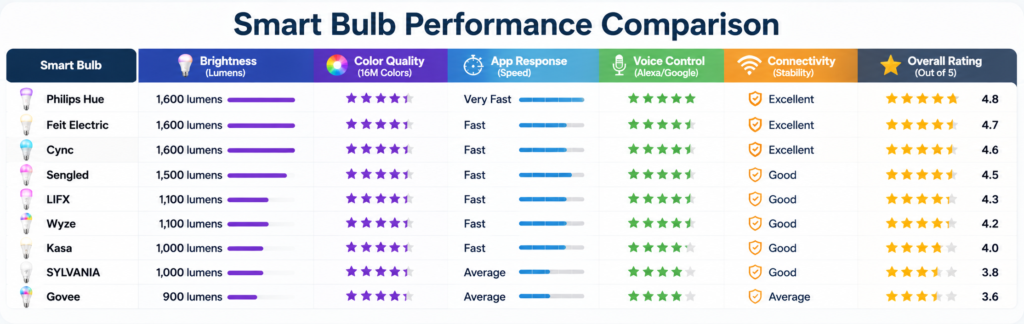
In the evaluation of smart light bulbs, there are four main criteria whose importance cannot be ignored when making comparisons between brands.
Brightness Comparison (Lumens):
- Philips Hue – 1,600 lumens (best for any room)
- Feit Electric – 1,600 lumens (same level as Philips Hue)
- Cync – 1,600 lumens (great main lighting bulb)
- Sengled – 1,500 lumens (plenty of light)
- LIFX – 1,100 lumens (good bright bulb)
- Wyze – 1,100 lumens (average light bulb)
- Kasa – 1,000 lumens (sufficient for average rooms)
- SYLVANIA: 1,000 lumens (adequate but not impressive)
- Govee: 900 lumens (lowest but okay for accent lighting)
Color Accuracy:
Philips Hue and LIFX shine in this aspect. Hue produces realistic colors, whereas LIFX uses vibrant color tones. Wyze and Kasa are good choices but are not as accurate as the more expensive brands.
App Response Speed:
Philips Hue reacts almost instantaneously, with Kasa and Cync being right behind. Wyze may take up to two seconds to respond, while SYLVANIA and Feit bulbs may feel a bit slow at times. Govee is also fast in responding but difficult to use.
Voice Control Performance:
Sengled leads the competition on Amazon Alexa, whereas Cync has no equal when it comes to working with Google voice commands. Hue is equally responsive regardless of the command used.
WiFi vs Zigbee vs Bluetooth
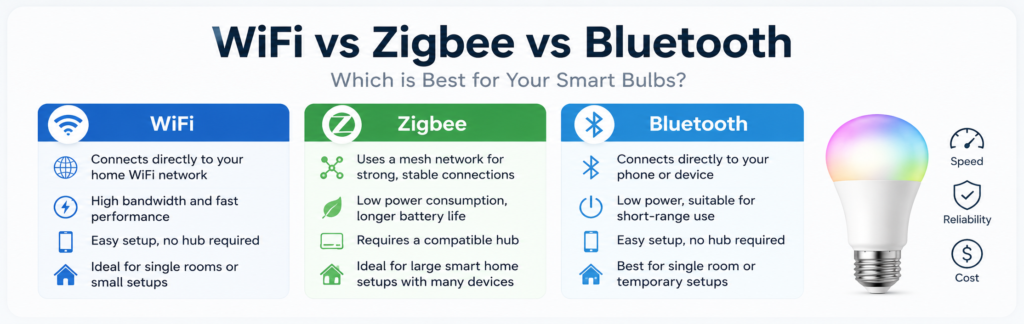
Understanding connectivity options helps you choose bulbs that’ll work well in your specific setup.
WiFi Smart Bulbs:
The WiFi lightbulbs connect directly to the WiFi network, hence there’s no need for an extra hub to operate them. They are easy to install since all one needs to do is connect them to the WiFi. But every smart bulb will consume some bandwidth, and therefore, if you have ten or more WiFi lightbulbs, they will affect your WiFi speed negatively.
Zigbee Smart Bulbs:
ZigBee uses a network that it generates by itself via a hub, such as Philips Hue Bridge or SmartThings. This makes the lightbulbs more dependable since they won’t interfere with your online Netflix activity. ZigBee uses the principle of communication between bulbs, which expands the range. Unfortunately, you have to purchase a hub to use ZigBee bulbs.
Bluetooth Smart Bulbs:
However, they rely on Bluetooth mostly for the setup process and local management purposes only. The range does not exceed around 30 feet, and therefore, one cannot manage these lights when outside since the devices require being in Bluetooth range or having WiFi.
When to choose what:
Select WiFi for up to five lights and convenience. Opt for Zigbee for an entire-house installation and the most stable performance. The main application of Bluetooth technology would be for backup purposes.
How to Choose the Best Smart Bulbs (Buying Guide)
Choosing smart lights that meet your needs can be easy if you know what is important to look at.
Brightness (Lumens Guide):
- 800-1000 lumens: Best for bedrooms, bathrooms, accent lighting
- 1000-1200 lumens: Great for living rooms, kitchens, offices
- 1200+ lumens: Great for big rooms, high ceilings, task lighting
It’s not enough to see how bright they can be; you should also make sure they dim smoothly to 1%. This is a game changer for evenings.
Color vs White Bulbs:
Color bulbs are slightly more expensive but provide much more versatility. Even when you believe that you would only need white lights, the fact that you could have red bulbs for your movie watching or blue for times when you want to concentrate makes up for the additional $10-15 for each bulb.
Compatibility (Alexa, Google, Apple):
Although most lightbulbs will operate using several assistants, there are some that perform well with others only. In case you have put your money in a particular system, get bulbs that can work effectively within that ecosystem. For instance, HomeKit compatible lightbulbs for Apple users.
Amazon Alexa Smart Home Devices Guide Google Home Smart Devices Guide
Budget vs Premium:
Budget bulbs (those under $15) are ideal if you want to test out smart lighting or light guest rooms. Higher-end bulbs ($40+) are worth the investment for your home’s main living areas, as they provide better color rendering and dependability. Medium-range bulbs ($15-$25) typically represent the best deal.
Hub vs No Hub:
Bulbs without hubs will be cheaper initially and much easier to install. Hubless devices will not last as long but will work well for a few bulbs. However, if you think about adding more than 5-6 bulbs in the future, consider getting hubless right away.
Best Smart Bulbs by Use Case
There are different considerations to be made depending on the situation. What follows is the list of smart light bulbs which would be suitable for each respective need.
Best for Alexa Users:
The Sengled Color Plus reigns supreme for the job. Seamless integration, flawless voice command compatibility, and effective control via Alexa groups are superior to those from other brands. Philips Hue is another good option but it costs considerably more.
Best for Google Home:
Cync by GE works best with Google Assistant and Google Nest compatibility. The commands are precise and quick, and the scheduling is compatible with the entire Google system. Another option that works perfectly well is the Philips Hue lights.
Best Budget Option:
Wyze Bulb Color gives amazing value for only $12.99. Get all the colors you want, sufficient lumens, and all the essential smart bulb functions. Ideal for experimenting with smart lighting at affordable prices or equipping rental homes.
Best for Gaming:
Entertainment-wise, Govee Smart Bulbs are top-notch. They sync music well and provide a fantastic screen sync effect. Plus, the gaming-oriented lighting effects provide excellent ambient lighting. Though not the brightest, they are ideal for accent lighting around gaming setups.
Best for Beginners:
TP-Link Kasa smart light bulbs have a perfect combination of features, dependability, and usability, especially for beginners. The app is user-friendly, easy to set up, and dependable with minimum troubleshooting.
Common Problems & Fixes
Even the highest quality smart LED bulbs can face certain troubles. Below are the most widespread issues and the ways to solve them.
Connectivity Issues:
It is the number one problem faced with smart lighting solutions. It often happens because of a poor signal or router overload. You should try placing your router closer to the bulb or installing an additional extender. In case of Zigbee bulbs, pay attention to the placement of your hub.
WiFi Overload:
In case you own more than 8 smart lightbulbs along with some streamers, gaming consoles, and phones, you may find your internet connection overloaded. In such a case, try considering switching to Zigbee lights or going for a mesh router system.
Voice Control Not Working:
This could mean that the connection between the device and the voice assistant was broken. Say the correct name of your smart bulb (say “living room lamp,” not simply “lamp”). Otherwise, unpair the device and try adding it back again.
Switch Issues:
The smart light bulb requires continuous supply of power to remain online; thus, the wall switch needs to remain turned on at all times. In cases where family members keep switching it off, you can either change the wall switch to an intelligent switch or cover it up with a note indicating that doing so will lead to problems.
Patience is important since many such problems are solved through either restarting the bulb or connecting it to the wireless internet.
Cost & Value Breakdown
Though pricey, you will find that the costs really work out in your favor rather fast when you start adding up the numbers.
Upfront Cost:
Affordable smart bulbs can be bought for about $10-15 per unit while more high-end ones go for $40-50 each. The average household is likely to have 8-12 bulbs, which would translate to costs ranging from $80 to as much as $600.
Energy Savings:
Smart bulbs employ LED technology, which consumes up to 75 percent less energy compared to traditional incandescent light bulbs. The most significant factor is the ability to automate the system so that lights do not remain on unnecessarily. People typically experience a decrease in lighting energy costs ranging from 60-80 percent.
Lifespan:
High-quality smart bulbs have a lifespan of 15,000 to 25,000 hours, which is far more than the lifespan of incandescent light bulbs, which last only 1,000 hours. If you use them for three hours every day, the bulbs will last at least 15-25 years. Although there may be electronic failures, but most brands offer 2–3-year warranties.
Value Comparison:
A $20 smart bulb that lasts for 15 years costs approximately $1.30 per year. A $5 traditional LED bulb that lasts for 10 years costs $0.50 per year. Therefore, you are spending an additional $0.80 annually for all of those capabilities such as scheduling, dimming, color-changing, and voice-control. It certainly does sound like a fair price.
While it may be difficult to put a number on the convenience aspect, it is definitely pleasant to have your lights come on automatically when you arrive home or to dim gradually at night.
Philips Hue vs LIFX
Although Philips Hue A19 and LIFX Color belong to the same class of smart light bulbs, they have distinct differences that distinguish their excellence.
Brightness:
The Philips Hue A19 light bulb reaches 1,600 lumens in brightness, while the maximum lumens produced by LIFX Color is 1,100 lumens. However, LIFX Color offers vibrant colors which may seem brighter than those of Philips Hue A19 in colored modes.
App Experience:
Hue’s application interface is better designed and more user-friendly. It performs better in terms of speed and stability, with improved structure while handling many bulbs. The LIFX app offers better creativity but can be quite confusing to use at times and even freezes.
Price:
Both products cost high-end price tags; however, Hue has a marginally lower cost at $49.99 compared to LIFX that has a higher cost of $54.99. In addition, Hue needs to buy a $50 hub in order to utilize all its functions, while LIFX can be used without such an accessory.
Ecosystem:
Hue has an extensive ecosystem of accessories that support lighting strips, outdoor lights, and third-party integrations. LIFX has a comparatively smaller ecosystem but they strive to improve the capabilities of each product. Hue is better if you want a complete lighting system setup while LIFX would be suitable for standalone bulbs.
Both are great options – Hue for reliability and ecosystem, and LIFX for performance and effect.
❓FAQs
What are the best smart bulbs?
In general, the best smart bulbs would be those from Philips Hue, TP-Link Kasa, and Wyze. The “best” is defined based on personal preference between performance, cost, and ecosystem compatibility.
Do smart bulbs need a hub?
However, not all smart bulbs need a central hub. Wi-Fi-enabled smart bulbs, such as Wyze, Kasa, and LIFX bulbs, directly hook up with your home’s router without needing a central hub. On the other hand, Zigbee smart bulbs require a hub to function optimally.
Which bulbs work with Alexa?
Almost all top manufacturers of smart bulbs have integrated their products with Alexa. However, the brands that integrate best with Alexa are Sengled and Philips Hue. The reason is that they have more sophisticated features such as grouping and scheduling.
How long do smart bulbs last?
Most smart lightbulbs have a lifespan of 15,000 to 25,000 hours of use, equaling 10 to 15 years. Most often, the LEDs last much longer than the electronic parts of the smart lights themselves, hence most malfunctions occur in the connection system.
Do smart bulbs save energy?
Indeed, energy savings with smart lights occurs in two ways. The first is the use of LED bulbs, which have an energy efficiency rating of 75% compared to the incandescent bulb. The second way is by minimizing power consumption through automation features.
🔗Related Articles
- Smart Lighting System in the USA: Complete 2026 Buyer’s Guide
- How to Set Up Smart Lighting at Home (Step-by-Step Guide)
- 9 Best Smart LED Light Strips (2026 Review)
- Best Budget Smart Lights Under $50 (2026) – Affordable Smart Lighting Guide
- Best Philips Hue vs LIFX vs TP-Link Kasa Smart Bulb Comparison for 2026
- Smart Lights Not Connecting? 10 Fixes That Work (2026 Guide)
- Gaming Room Smart Lighting Setup (RGB Guide 2026)
- Best Smart Lighting for Bedrooms (2026 Setup Ideas)
- Smart Lighting for Small Apartments (Budget Setup Guide 2026)
🚀Conclusion
Following tests of numerous products, the top smart light bulbs of 2026 fall into three distinct categories. Philips Hue continues to be the top brand for those seeking the highest-quality product with all the bells and whistles. TP-Link Kasa offers great value for money without sacrificing functionality. For those who require something affordable, Wyze Color bulbs provide an impressive range of functionalities for less than $15.
This space has developed significantly where affordable choices feature millions of colors, voice controls, and great apps. All of these products are excellent options, and one is not better than another, so choose by how much you want to spend and which ecosystem you prefer.
What should you do? Try out 1-2 smart light bulbs at first in your most frequently used rooms. Once you get a taste of what is like using such lights, you will want to install them throughout the house.