
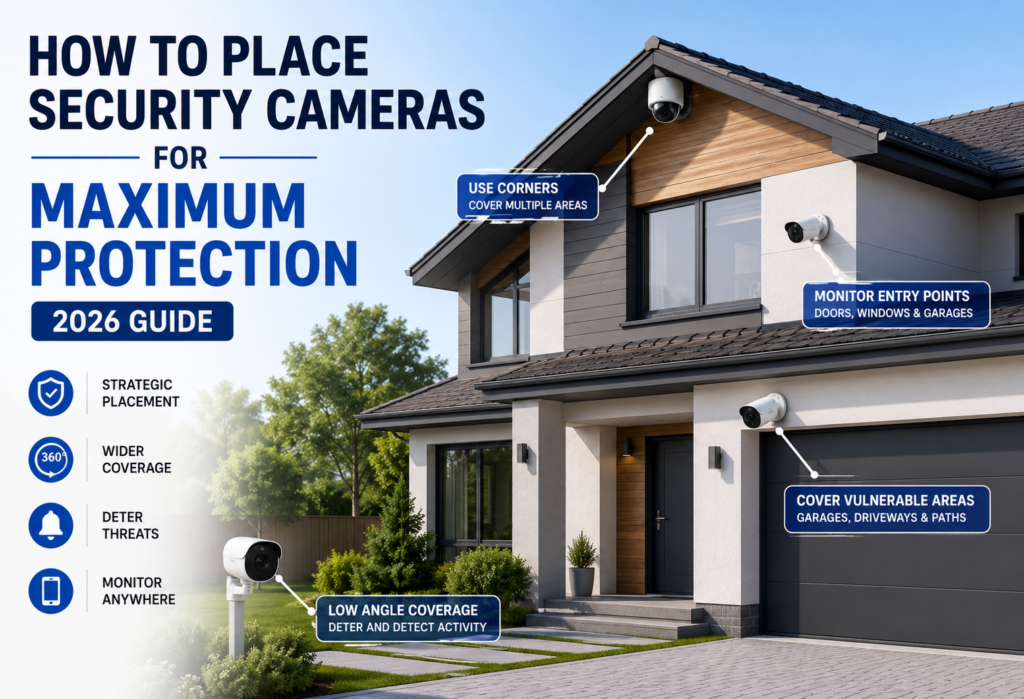
Every day people buy security cameras for their homes. They spend a lot of money on these cameras. Sometimes the cameras do not work like they should. They do not catch the guys when they break in. This is because the cameras are not put in the place. When you placed security cameras too high, near the front door. So, when a burglar came, he just walked around the spot where the cameras could not see.
Knowing where to put security cameras is just as important as picking the camera system.. You could have an advanced 4K camera that can see at night and detect people with AI but if its pointing at a wall positioned where it can’t see intruders clearly, it’s just a waste of money. It’s like having a decoration that doesn’t do anything.
The difference between security and bad security usually comes down to where you put things. If you put security cameras in the place it can mean you catch someone doing something wrong and get useful video. If you do not put them in the place, you just get video that shows nothing. When security cameras are put in the spots, they cover all the areas, around them so people cannot hide and you get video that is clear and helpful.
In this guide I will tell you all about placing cameras. You will learn how to find the spots to install them. These spots are where people are most likely to enter your home. You will also learn how to avoid mistakes when installing cameras. This way you can have a security system that really keeps your home safe.
Table of Contents
Why Security Camera Placement Matters
he security camera’s location is key it determines their effectiveness in protecting your property and stopping threats. When security cameras are not placed correctly, they cannot do their job properly. Homeowners have to be careful when installing security cameras to ensure they are placed in the spots.
Eliminates blind spots Criminals usually watch homes for a while before trying to break in. They look for places where cameras can’t see them. When you put cameras in the spots you take away these hiding places that intruders count on. You should be able to see every corner, door and possible hiding spot from at one camera.
Improves detection accuracy the security cameras can see what is important. If a security camera is high up it might miss the face of someone. If a security camera is too low someone can easily damage it or cover it up. He security cameras need to be at the height and the right angle so you can get clear video that shows everything clearly and helps identify the intruders with the security cameras.
Helps capture clear footage The camera is in the right spot. If the video is blurry or too dark, it is not going to be any help all. When we put the camera in the place we have to think about the light conditions and obstructions that might get in the way and the areas that need to be watched very closely.
Supports law enforcement When the cameras are not in the right spot the footage is not very good. It is either too blurry or it does not show everything that happened. It is not much help to the police when they are trying to figure out what happened. The law enforcement people are doing a job, and they need all the help they can get from things, like camera footage.
The reality is that camera placement can make or break your entire security investment.
Key Principles of Security Camera Placement
To get the view you need to know where to put your cameras. If you do this you will not make the mistakes that people often make. This way your property will be very safe.
🎯Cover Entry Points
Doors and windows are what burglars usually target. Statistics show that than 80 percent of burglars enter through doors and windows. Your security camera plan should focus on these areas first. It’s best to place cameras to catch anyone walking up to doors or windows, on the ground floor.
Consider how one might arrive at your door. Place cameras along their arrival path, allowing you to have early notice and visual evidence of who is trying to enter your home. Be sure that you are not just placing a camera directly on your door – get video evidence of the areas around the door as well.
📐Height and Angle
Ideal height ranges from 8 to 10 feet for most residential applications. This height is high enough to prevent easy tampering while still low enough to capture clear facial features. I’ve made the mistake of mounting cameras too high before, and the resulting footage showed nothing but the tops of people’s heads.
The angle is equally important. Tilt your security cameras slightly downward to capture faces rather than just body shapes. A camera mounted at 10 feet should angle down about 15-20 degrees to get the optimal view of someone standing at normal height.
Avoid glare and obstructions by carefully surveying the area during different times of day. Tree branches, decorative elements, or even spider webs can block your view. I learned to check camera views during different seasons because trees that seem fine in winter can completely block your security camera view once they leaf out in spring.
💡Lighting Conditions
Avoid direct sunlight Make sure to avoid bright daylight exposure that can lead to washed-out footage or shadows that may obscure vital information. When there is no way around positioning cameras in such a way that they will be exposed to direct sunlight at some point during the day, opt for cameras with WDR capabilities.
Use night vision effectively by considering its limitations. Infrared cameras function very well in total darkness but may have difficulty with varying light situations. Locate your cameras in a way that will not be affected by any lights near them, such as porch lights or street lamps.
📡WiFi Signal Strength
Placement near router or strong WiFi a reliable connection between the camera and the network. The worst thing is when you miss vital moments because the camera was not working due to poor connectivity. Before settling on your camera locations, check the WiFi strength using your mobile phone.
Think about WiFi extenders or mesh networks if you find yourself placing cameras in places with poor connectivity. Correct camera positioning at home will make sure you have maximum coverage, but having good coverage will mean nothing if your camera is not connected to your recording device.
Best Places to Install Security Cameras
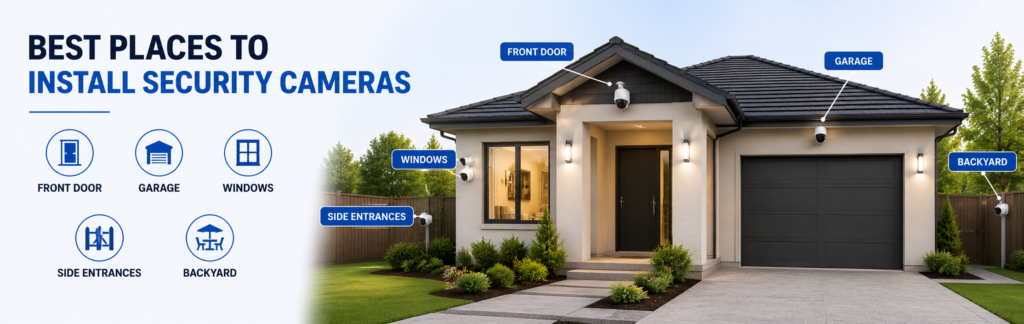
The correct positioning of security cameras depends on the knowledge of where there is maximum safety for your money. Below are some of the key places that homeowners should consider according to crime data and security experts.
🚪Front Door (Most Important)
The front door area accounts for 30-40% of all burglaries, based on the FBI stats, and that is why you will have to concentrate your efforts here. Yet, do not install a camera simply aimed at the door – try to cover the whole area with cameras, including walkways and stairs.
What I would suggest you doing is installing at least two cameras. One of them should be placed rather high and give you a view of the whole front yard, and if it is possible, a second security camera that will give a close-up of a criminal. That way, you will be able to identify the criminals and dissuade them from the action.
Think about the time your front door gets the most traffic. The morning and evening hours can bring some difficulties because of poor lighting. Try testing your security camera during such hours.
🚗Garage and Driveway
Monitor vehicles The last thing that you should monitor is vehicles and one of the most commonly used entry points to your home. Burglars target garages due to their high value and easy access into your house. Most people forget to lock the door leading from the garage to their house. Thus, accessing the garage can be very risky.
In order to protect your garage, install security cameras not only in front of the door but also inside the garage if you can. It will be useful for monitoring who approaches your home through the driveway and gives time to solve any arising problem. Personally, I have observed that cameras installed in the driveway work as good deterrents. Most of the times, criminals decide to leave since they know that everything is being recorded.
Remember the importance of having a side entrance to the garage. Most garages are equipped with service doors or windows that are harder to see from outside, making them convenient points of entry for intruders.
🪟Windows (Ground Level)
Prevent easy entry Ensure that it is difficult to gain entry through observation of windows that are visible from the outside, but especially those that are not visible from the street. Ground-floor windows are a very popular entry method for burglars, especially if they are concealed behind landscaping.
Concentrate on larger windows where a person can climb through as well as windows that give access to the more valuable parts of your house. Windows located in the basement are frequently ignored, yet they may be more susceptible to crime because people tend not to notice them.
Make sure the security cameras are set up so that they can record any person entering the vicinity of the windows, rather than just those who are in the act of committing the crime.
🌳Backyard
Hidden access points Your back yard hidden access points should be monitored since they cannot easily be seen from the road. Burglars love the back entrance because they can operate without being watched by anyone else.
Most backyard areas usually have several access points, such as back doors, sliding doors, basement doors, or gates from side yards. These areas must be included in your camera coverage.
Take into account the arrangement of your backyard space and find spots where a thief can lurk while trying to gain entry. Decorations, big trees, or sheds may create blind spots that a criminal can use. When deciding on where to mount your cameras, put yourself in a thief’s shoes and map out how you will approach.
🏠Living Room and Main Hallways
Indoor monitoring purposes other than ensuring safety. Indoor cameras will help you to watch your house even when you’re not there, monitor your kids or elders, and also gather evidence in case of any burglary.
Position the interior security cameras strategically in those traffic spots that will record everyone who is moving about inside your house. The best places for positioning such cameras are hallways, since they will always be used as chokepoints.
Think about security cameras that can be used in two ways, both for convenience and security. Today’s indoor cameras have built-in two-way communication devices, which enable you to talk to family members or warn intruders.
👶Kids’ Rooms and Elderly Care Areas (Optional)
Safety monitoring system could give peace of mind in cases where there are specific concerns with the family. In such cases, privacy is an important factor. If any camera is to be placed inside a bedroom, it must be made clear to all members of the family.
If there are elderly members in your family, then camera surveillance may be used to monitor any emergency situation or health-related problems. Install cameras in such a way that they do not compromise people’s privacy.
Think about the smart security camera system with a feature of detecting the presence of a person. It could be useful to be informed if an individual who is usually moving around suddenly stops making such movements because of any health issues.
It is crucial to have systematic thoughts regarding the weaknesses of your property while also ensuring that you take into consideration both the privacy and security issues. The placement of security cameras within your home will depend on your home layout, but the following are the primary zones to consider.
Indoor vs Outdoor Camera Placement
Understanding the differences between indoor and outdoor security camera placement helps you choose the right equipment and positioning for each environment.
| Feature | Indoor | Outdoor |
|---|---|---|
| Placement Focus | High-traffic rooms and hallways | Entry points and perimeter |
| Weatherproof Rating | ❌ Not required | ✅ Essential (IP65 or higher) |
| Coverage Area | Limited to room size | Wide area coverage possible |
| Power Options | Easy electrical access | May require battery or solar |
| Privacy Concerns | High – family living spaces | Lower – public-facing areas |
| Installation Complexity | Simple mounting | Weather sealing required |
Indoor security cameras should be placed in such positions inside buildings as would allow viewing several places at once.It would be better to place such cameras in corners since they will provide the largest surveillance area. Indoor security cameras do not require any protection against weather conditions, you have more options for discreet placement and can often use smaller, less obvious models.
Outdoor security cameras When installing outdoor cameras, one needs to choose the most durable housing for them. It would be better to put them under the roofs to increase their lifetime. Due to the large number of areas which can be covered by one outdoor camera, one would require fewer cameras for installation than indoors. Moreover, they need to withstand all the weather conditions that can occur.
The major difference between installing the two kinds of cameras lies in that indoor cameras only need to survey a known territory, whereas outdoor ones have to detect approaching threats from multiple directions.
Where NOT to Place Security Cameras
Not only picking appropriate spots but also avoiding inappropriate spots is equally crucial. The following list contains those places which would be a source of trouble rather than offering any solution.
Bathrooms Privacy and legal concerns arise from bathrooms. Cameras should never be used within bathroom walls, even if the bathroom is one’s own space. Not only family bathrooms but guest bathrooms are also covered by this rule and could potentially make one legally liable if people are caught on tape without their consent.
Direct sunlight areas will produce bleached images during the day and will cause harm to your cameras in the long run. In case you have to install a camera in an area that will be exposed to direct sunlight, purchase cameras that are made for glare situations.
Too high or too low Both excessively high and low positioning severely undermine effectiveness. Cameras installed above 12 feet would be unable to capture any useable images of people’s faces, whereas cameras placed lower than 7 feet can easily be destroyed or covered. This problem was faced by many, when cameras installed too low on the wall was rendered useless just by placing a jacket over it.
Behind glass is another major concern. Even though installing your camera behind glass may look like a good idea, it often results in footage becoming highly distorted and unusable. Besides, it ruins night vision through blocking infrared radiation.
Security Camera Placement for Different Home Types
The design of your house affects your security camera setup quite a lot.
🏢Apartments
Focus on doors and interiors You should concentrate on the doors and interiors, since you cannot alter anything concerning the exterior design of the building. Your main concern here should be securing your apartment door, any windows accessible to you, and monitoring the interiors. Most tenants tend to ignore the significance of monitoring the corridor around your house.
You can opt for portable or easily detachable setups that will not breach your lease agreement. You can opt for battery-operated or adhesive-mount cameras.
🏡Houses
Full perimeter coverage It’s feasible and strongly suggested to have coverage of your whole perimeter when it comes to stand-alone homes. With cameras properly installed, you will be able to see everything from all sides of the property with overlapping zones. It would be smart to start securing more vulnerable areas and then continue based on your budget.
Think about some special features of your home that would make it necessary to use other techniques. For example, two-story houses require certain methods, while ranch style houses don’t ,and homes with attached garages have different vulnerabilities than those with detached garages.
🏘Villas and Large Homes
Multi-camera systems are necessary for large-scale premises. For proper coverage, you will require at least 6-10 cameras. Think about getting a central monitoring station that can manage several HD feeds concurrently.
Large homes are characterized by having more than one building, complex landscaping, and lengthy driveways that demand special attention when it comes to surveillance techniques. You may have to think about installing security cameras with higher range capacity.
Common Mistakes to Avoid
There are several things to learn from other people’s mistakes to avoid wasting time, money, and energy on installation.
Ignoring blind spots Failure to take into account the presence of blind spots is the most frequent mistake of people performing installation procedures themselves. Check for blind spots yourself and correct the placement of the cameras.
Poor WiFi coverage Bad WiFi signal strength can result in a loss of recordings or connection failure. It is essential to check the wireless connection before the final installment because weather, season, and even activities within the household can impact its performance.
Overlapping anglesoccur when people choose cameras and install them without a proper plan and end up installing extra cameras because of double monitoring of one and the absence of monitoring in other areas.
Not testing cameras When there is no testing after the installation of the cameras, it means that the problem will come to light at times when the system is needed. Make sure that all cameras are functioning properly.
Pro Tips for Maximum Protection
Using more advanced tactics will make your security system much more efficient than just placing the cameras properly.
Combine cameras with sensors to have a whole ecosystem of your security system. Door and window sensors will help activate the recording process and send notifications in case the cameras do not notice the movement at first. Motion sensors will activate the cameras without wasting extra storage space and allowing easier reviewing of recorded events.
Use motion detection alerts I would suggest using motion detectors, but be careful when setting them up because it may cause many false alarms. You can use modern cameras that offer motion zone detection, which allows ignoring busy streets, while still detecting movement near your property. Start with wide zone settings and narrow them down depending on your
Connect to mobile app Integrate with mobile application monitoring to allow for real-time threat management. Most cases of security breaches could have been avoided if there was instant notification and the individual could react by contacting law enforcement, or remotely triggering lighting and alarms.
Use backup storage Ensure backup storage options are included to avoid losing any vital recordings. There are many ways to ensure your recordings are safe in case of damage to the device itself, including cloud storage, network storage, or even simply SD card backups.
To learn more about creating a fully integrated security system, see our guide to constructing an advanced smart home security system.
❓FAQs
Where should security cameras be placed outside?
Start with the points of entry: front door, back door, garage door, and first-floor windows. Next, widen the scope to include approaches to your property such as driveways, sidewalks, and side gardens. It’s important to place cameras where they can film the approach to vulnerable spots rather than the spots themselves.
How high should cameras be installed?
The recommended height is 8-10 feet for residential use. This ensures that the camera can’t be easily interfered with but captures clear images of people’s faces. Don’t install above 12 feet unless you’re after a wide-angle view of larger locations.
How many cameras do I need?
An average house will have at least 4-6 cameras: for entry door, rear door, garage, driveway, and one or two more cameras covering the sides and interior. Bigger houses will have at least 8-12 cameras for full coverage. Begin with vulnerable spots and upgrade the camera network gradually.
Can cameras work without WiFi?
Yes, some cameras are able to record to the memory cards directly from the camera or even to external hard drives or other storage media without being connected to the internet. This way, however, there won’t be any remote access to the video and alerts.
🔗Related Articles
- Smart Home Security Systems in 2026 (Expert Buyer’s Guide)
- How to Build a Smart Home Security System (Ultimate Guide 2026)
- Schlage Smart Lock Review (2026): Is It Worth Buying?
- Best Smart Security Cameras for Home in 2026 (Complete Buyer’s Guide)
- Best Smart Video Doorbells for Home Security in 2026 (Complete Buyer’s Guide)
- Best Smart Locks for Home Security (2026 Guide)
- Common Smart Home Security Mistakes to Avoid (2026 Guide)
🚀Conclusion
The positioning of your security cameras will be the determining factor between having a working security system and merely feeling safe with it. The position of your security cameras will affect their effectiveness in terms of deterring intruders, capturing any activity, and being able to use the footage to make cases against any culprits.
Do not forget that a well-designed system of surveillance should be built by recognizing possible weak spots of the particular object and arranging cameras in such a way to cover these weak spots effectively. Begin with the most vulnerable areas, for example the front door, and gradually increase coverage according to your budget. It is important to examine how your cameras operate in different lighting situations.
Do not lose your money from ineffective placement in relation to your investment in home security technology. Place your cameras strategically and do not fall victim to these common mistakes made with security camera placement, since effective placement of an ordinary camera is better than misplaced high-tech equipment.
Ready to choose the right security cameras for your planned locations? Check out our detailed guide on “Best Smart Security Cameras for Home in 2026 (Complete Buyer’s Guide)“ to find models that match your specific placement needs and budget requirements.